
The short answer
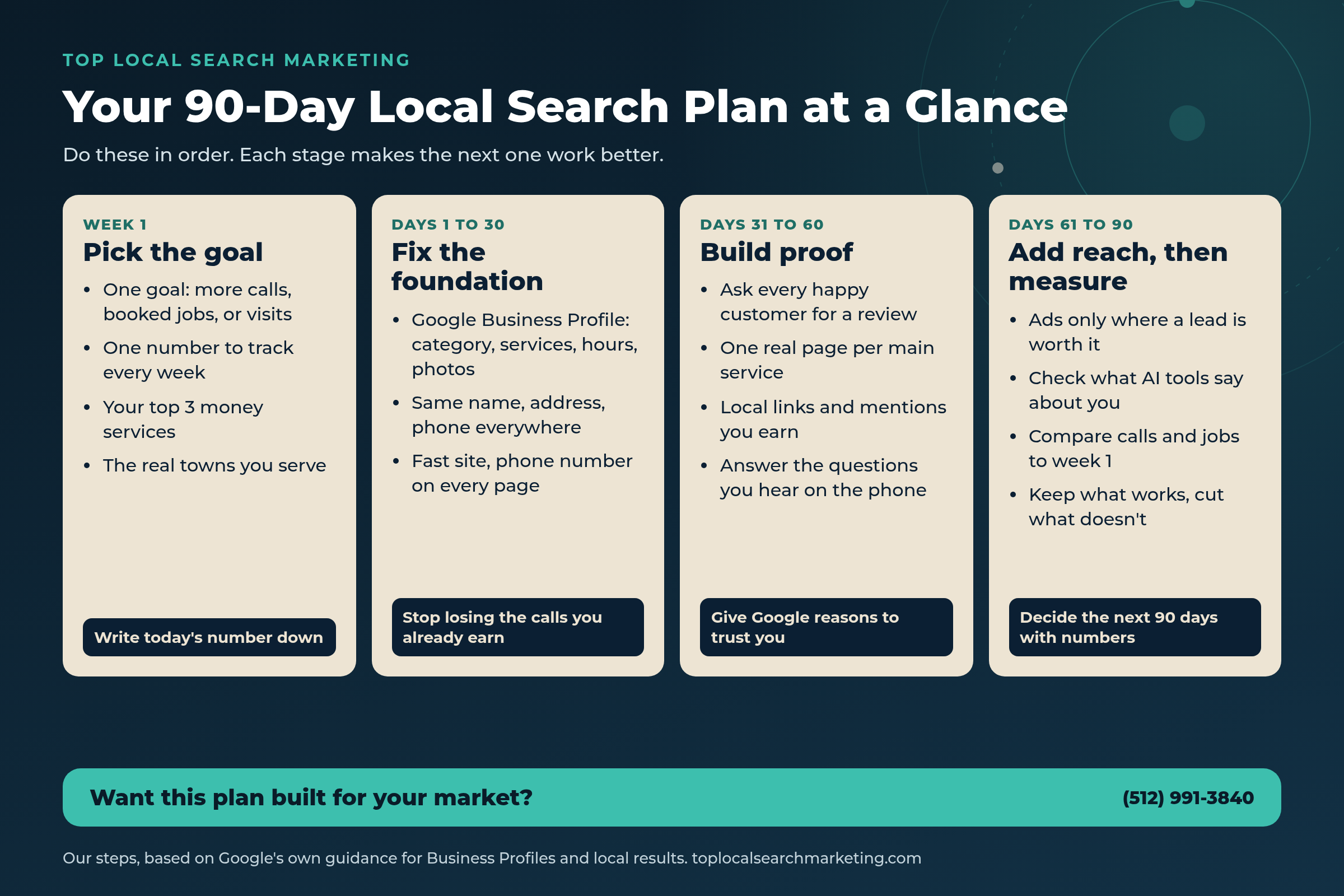
A good local search marketing strategy is a short list of the right things, done in the right order, and judged by calls and booked jobs. Pick one goal, fix your Google Business Profile and listings, build real service pages and a steady review habit, then add ads and AI visibility where they pay. The 90-day plan below shows exactly what to do and when.
Most local businesses don’t have a strategy problem. They have an order problem. They post on social media, try some ads, maybe redo the website, and the phone is still quiet. Local search rewards the basics done well and done first. This guide gives you the order, the steps, and the numbers to watch. If you’re brand new to the topic, start with what local search marketing is.
In this guide
- What a local search strategy includes
- How Google picks local results
- Step 0: one goal, one number
- Days 1 to 30: fix the foundation
- Days 31 to 60: build proof
- Days 61 to 90: add reach and measure
- Month-to-month local search management
- How to measure it
- Why a strategy stalls
- Do it yourself or hire an expert?
- More than one location
- FAQ
What Is a Local Search Marketing Strategy?
It’s your plan for getting found and called when people nearby search for what you do on Google Search, Google Maps, and AI tools like ChatGPT. A real strategy says three things: which parts you’ll work on, in what order, and how you’ll know it’s paying off.
Here are the parts most local businesses need. You don’t need all of them on day one. This is also what solid local search marketing services should cover.
| Part | What it does | When to start | What to measure |
|---|---|---|---|
| Google Business Profile | Gets you into the map results and the profile people see first | Week 1 | Calls, direction requests, website clicks |
| Listings | Keeps your name, address, and phone the same everywhere | Days 1 to 30 | Wrong or duplicate listings fixed |
| Service and area pages | Gives Google and customers a clear page for each job and area | Days 1 to 60 | Search Console impressions and clicks, calls from the site |
| Reviews | Builds trust with buyers and with Google | Days 31 to 60, then forever | New reviews per month, reply rate |
| Local links and mentions | Shows you’re a known, real business in your area | Days 31 to 90 | Real local sites that mention or link to you |
| Local search ads | Buys calls now while the free results grow | Days 61 to 90, if a lead is worth it | Cost per booked job |
| AI search visibility | Helps AI tools name you when people ask for a recommendation | Days 61 to 90 | How often you’re named in repeat checks |
| Tracking | Shows which work brings calls and jobs | Before anything else | Calls, forms, booked jobs |
How Google Decides Who Shows Up in Local Results
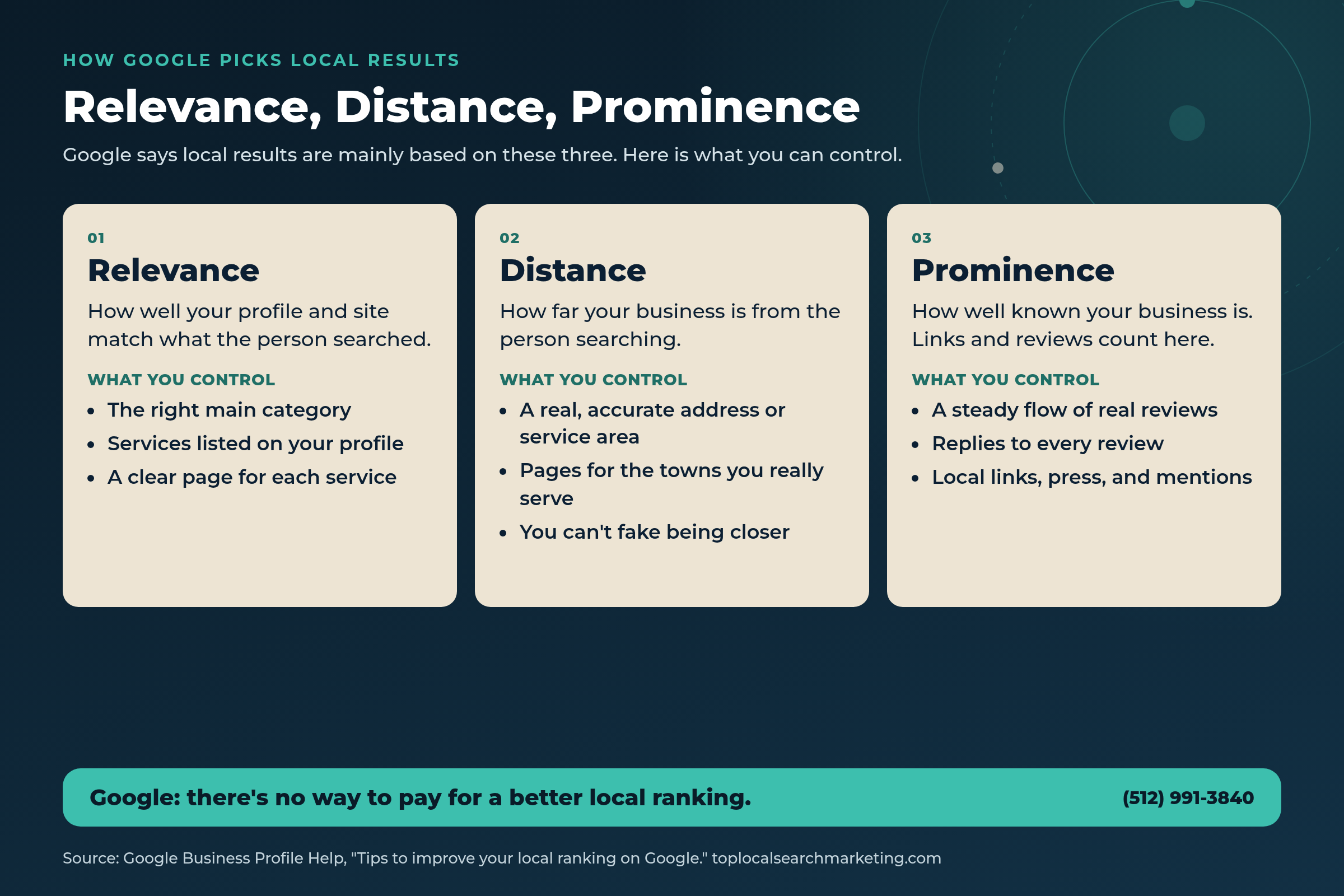
Google says local results are mainly based on relevance, distance, and prominence. Your whole strategy should feed those three things.
Relevance: do you match the search?
Relevance is how well your Business Profile matches what someone searched. Google’s advice is simple: give complete, detailed business info. That means the right main category, your real services, and a website page for each one.
Distance: how close are you?
Distance is how far your business is from the person searching. You can’t change where you are, so don’t fake it. Set an accurate address or service area and build pages for the towns you really serve.
Prominence: how well known are you?
Prominence is how well known your business is. Google says this uses things like how many websites link to you and how many reviews you have, and that more reviews and positive ratings can help. This is where reviews, local links, and mentions earn their keep.
One more line from Google worth remembering: “There’s no way to request or pay for a better local ranking on Google.” If someone guarantees you the top spot on Maps, walk away.
Step 0: Pick One Goal and One Number
Write down the one outcome you want, such as more booked jobs from Google, and the one number you’ll watch every week, such as phone calls from your Business Profile and website. Set up call tracking and a simple form alert before you change anything, so you have a “before” number. Rankings are useful, but calls and booked jobs pay the bills. Our analytics and call tracking page explains how we set this up.
Pick your money services and your real service area
List the three services that make you the most money and the towns you actually want work in. A roofer might pick roof replacement, storm repair, and inspections. An HVAC company might pick AC repair, furnace installs, and maintenance plans. Everything in the next 90 days points at that short list.
Match each kind of search to the right page
“emergency plumber near me.” These people want to call now. Send them to your Business Profile and a strong service page with your phone number up top.
“best roofer in [your city].” They’re choosing between you and two others. Reviews, project photos, and clear answers win here.
“how much does a new water heater cost.” They’re not ready yet. A short, honest article that links to your service page keeps you in the running.
Days 1 to 30: Fix the Foundation
The first month is about not losing the customers who already find you. Google says businesses with complete and accurate info are more likely to show up in local results, so start here.
Google Business Profile
- Verify your profile if you haven’t. Google says verified businesses are more likely to show up.
- Use your real business name, the one on your sign and your trucks. Google’s rules don’t allow extra keywords in the name.
- Choose the most specific main category. Google says to use the fewest categories it takes to describe your core business.
- List every service in the words customers use, and set your real hours and phone number.
- Add real photos of your team and your work.
Details in our Google Business Profile optimization guide.
Listings
Make your business name, address, and phone number match everywhere: Google, Apple Maps, Bing, Yelp, Facebook, the BBB, and your industry directories. Fix old addresses and old numbers, and merge duplicates.
Your website basics
Every main service needs its own page that says what you do, where you do it, and how to reach you. Put your phone number at the top of every page. Make sure the site loads fast on a phone, because that’s where most local searches happen.
Days 31 to 60: Build Proof
Month two is about giving people, and Google, reasons to trust you.
A steady review habit
Ask every customer for a review with a direct link, and reply to every review, good or bad. Aim for a steady flow each month, not a burst. Two rules from Google’s review policy matter here: don’t offer anything in exchange for reviews, and don’t ask only your happy customers. Google calls out “selectively” asking for positive reviews as not allowed. See reputation and listings management.
Service area pages
Add a page for each area you really serve, with local photos, local reviews, and how you work there. Skip towns you don’t serve. Pages that only swap the city name rarely help and can drag the site down.
Local links and mentions
Get your name on real local websites: your chamber of commerce, the suppliers you buy from, local sponsorships, community events, and local news when you do something worth covering. Never buy link packages. A handful of real local mentions beats hundreds of junk links.
Local content that answers real questions
Write short, honest answers to the questions customers ask you on the phone: prices, timelines, what to do in an emergency, how to choose. Link each one to the matching service page.
Days 61 to 90: Add Reach and Measure
Local search advertising, only where it pays
Google Ads and Local Services Ads can bring calls quickly while your free visibility grows. Start small, track every call, and keep only what turns into booked jobs. New to ads? Read what local search advertising is and Local Service Ads vs. Map Pack vs. Ask Maps, or see our Google Ads management.
AI search visibility
AI tools like ChatGPT, Google AI Mode, and AI Overviews now recommend local businesses. They lean on the same proof Google does: a complete profile, real reviews, consistent listings, and a clear website. A September 2026 BrightLocal study of about 200,000 local AI searches found a few things worth knowing:
- Ranking on Maps doesn’t carry over automatically. Google Maps named the tracked business in 66% of searches, while the AI tools named it in only 32% to 38%.
- Answers change from run to run. Repeat searches overlapped only 20% to 33% on average, so one check tells you very little.
- Your own website and profile matter. Business websites made up 42% of all citations, and Google Business Profile was the top single source at about 29%.
How to check what AI says about you
-
Ask like a customer
Type the question a customer would ask, such as “best HVAC company near [your town],” into ChatGPT and Google AI Mode.
-
Ask more than once
Run the same question three or four times on different days. Write down who gets named each time.
-
Fix the gaps
If competitors keep showing up and you don’t, look at where AI is pulling their info from: their reviews, their listings, their service pages. Then close the gap. More on AI search optimization.
Review the numbers
At day 90, compare calls, forms, and booked jobs to your week 1 number. Keep what worked, cut what didn’t, and plan the next 90 days.
What Local Search Management Looks Like Month to Month
Local search management is the ongoing upkeep after the first 90 days. The foundation is built. Now you keep it accurate, keep proof coming in, and keep checking the numbers. Here’s a simple checklist.
Every week
- Reply to new reviews
- Answer messages and questions on your profile
- Add a few new photos of real jobs
- Check that calls are being answered
Every month
- Check your profile for edits you didn’t make
- Look at Search Console for searches you almost rank for
- Improve or add one service or area page
- Compare calls and booked jobs to last month
Every quarter, step back: rerun your AI checks, look at your top three competitors, and set the next 90-day goal.
How to Measure Whether Your Strategy Is Working

Watch three places, and judge everything by booked jobs.
- Your Business Profile performance. It shows views, the searches people used to find you, calls, direction requests, and website clicks. One catch: Google counts a “call” as a tap on the call button, not an answered call. Compare it with your phone log.
- Google Search Console. It shows which searches your website appears for, your average position, and how many people clicked. Free and worth setting up on day one.
- Your call log and job list. This is the truth. Ask every new customer how they found you, and write it down.
A real example: this page
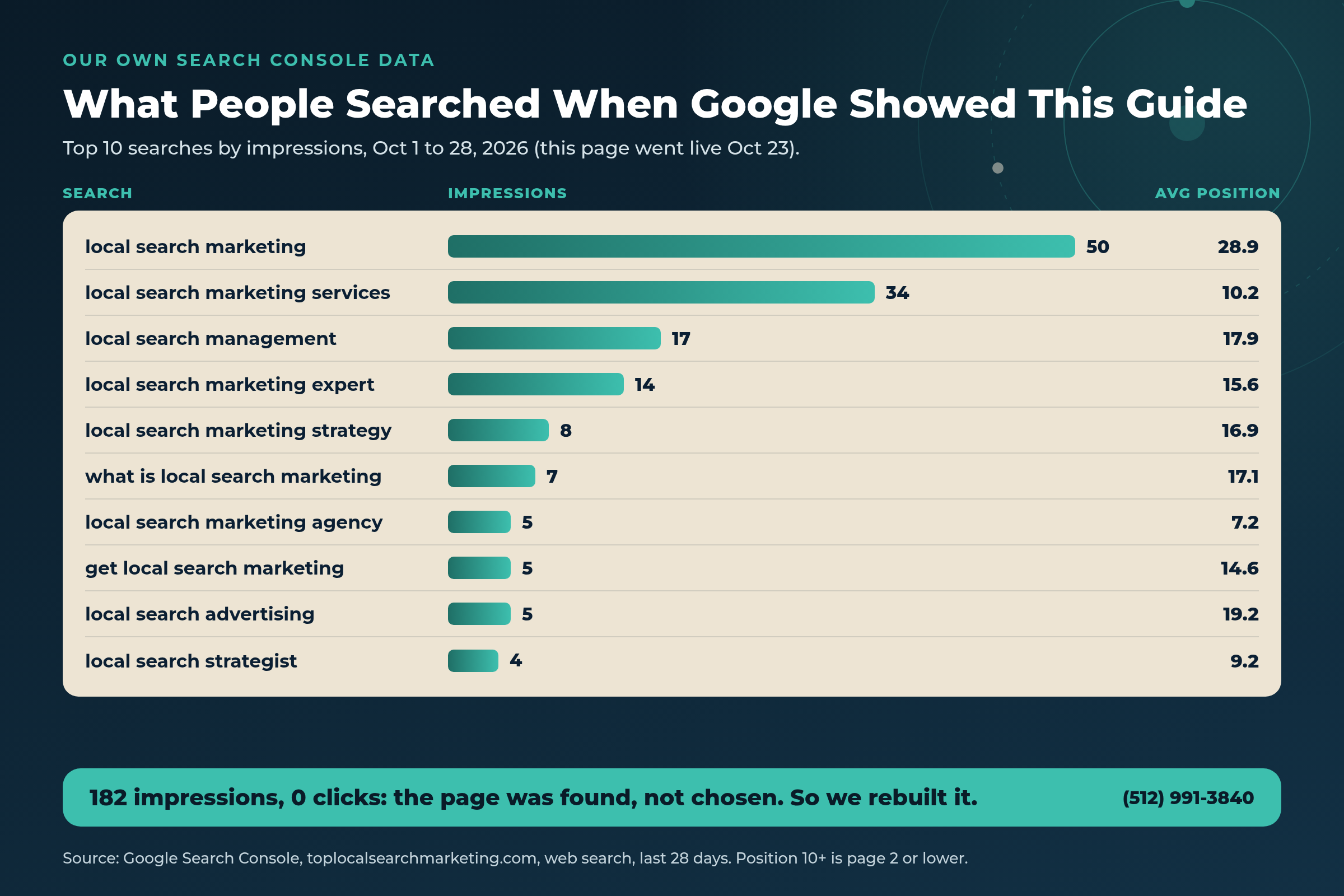
We hold our own pages to the same standard. Here’s what Search Console showed for this guide in its first days live. Google showed it 182 times, mostly in positions 10 to 29, which is page two and lower, and nobody clicked. The searches told us what people wanted: services, management, and whether to hire an expert. So we rebuilt the page to answer those questions.
Why a Local Search Strategy Stalls: A Quick Diagnosis
If the plan isn’t working, the symptom usually points to the cause.
| What you see | Likely cause | What to do first |
|---|---|---|
| You don’t show up at all | Profile not verified, suspended, or wrong main category | Check verification status and your main category |
| You show up near your office only | Distance, plus thin proof in other towns | Real area pages, reviews from customers in those towns |
| Lots of views, few calls | Weak photos, few or old reviews, missing services | Fresh photos, a steady review habit, full services list |
| Calls, but few booked jobs | Missed calls, slow callbacks, wrong-fit leads | Listen to recorded calls and fix answering and follow-up |
| Site gets impressions, no clicks | Page ranks low or the title doesn’t match the search | Rewrite the title and answer the question up top |
Do It Yourself or Hire a Local Search Expert?
You can do the first 30 days yourself if you have a few hours a week and you’re comfortable in your Business Profile. Hire help when you’re in a crowded market, you have several locations, or the work keeps sliding because you’re busy running the business. If you’d rather hand it off, that’s the work we do every day as a local search marketing agency.
DIY works when
- You’re in a smaller market with few competitors
- You’ll stick with a weekly routine
- You mostly need profile, listings, and reviews cleaned up
Hire an expert when
- Competitors have far more reviews and pages
- You have more than one location
- You need ads, pages, and tracking working together
- Your time is worth more on the job
What does local search marketing cost?
It depends on how competitive your market is, how many services and locations you have, how much work your profile and site need, and whether ads are part of it. We break down real price ranges and what you should get for them in how much local SEO services cost.
How to choose a local search marketing company
- They report calls and booked jobs, not just rankings.
- You own your Business Profile, website, and ad accounts.
- They don’t guarantee number one rankings. Google says nobody can pay for that.
- Short terms or month to month, so they keep earning it.
Our full checklist: how to choose a local search marketing company.
If You Have More Than One Location
The same plan applies to each location, with one Business Profile and one location page per real address. Google allows one profile per business location. Keep naming, categories, and reporting consistent across all of them. See multi-location marketing.
No storefront? Service-area businesses
If you go to your customers, like most plumbers, roofers, and cleaners, Google says to hide your address and set a service area instead. Keep that area realistic. Google says it shouldn’t stretch farther than about two hours’ drive from where you’re based. A rented mailbox or virtual office isn’t eligible for a profile.
Common Strategy Mistakes
- Starting with ads before the profile is fixed. You pay to send people to a weak listing.
- Measuring rankings instead of calls. A ranking that doesn’t ring the phone isn’t a win.
- Copy-and-paste city pages. They rarely rank and can drag the site down.
- Asking only happy customers for reviews. It’s against Google’s policy and can cost you reviews.
- Fake addresses and keyword-stuffed names. They can get a profile suspended.
- Doing everything at once. Pick the next right thing and finish it.
- Trusting ranking guarantees. Nobody controls Google.
FAQ
Local Search Strategy FAQ
It’s a plan for getting a local business found and called from Google Search, Google Maps, and AI answers. It covers your Business Profile, listings, website pages, reviews, local ads, and AI visibility, done in a sensible order and measured by calls and booked jobs.
Set up call tracking so you have a starting number, then fix your Google Business Profile and make your listings consistent. Those changes usually matter more than anything else in the first month.
Profile and listing fixes can change what customers see within weeks. Organic rankings and AI recommendations usually build over several months, depending on your competition.
It’s the ongoing upkeep after the first 90 days: replying to reviews, keeping your profile and listings accurate, adding photos and pages, and checking calls and booked jobs every month.
Local SEO is the free side: your Business Profile, listings, website pages, and reviews. Local search marketing is the bigger plan. It includes local SEO plus paid local ads and AI search visibility.
Not always. Ads can bring calls quickly while your free visibility grows. Start small, track every call, and keep only what turns into booked jobs.
No. Google says there’s no way to request or pay for a better local ranking. Treat any ranking guarantee as a red flag.
No. Service-area businesses that go to customers can have a Business Profile with the address hidden and a service area set. A rented mailbox or virtual office isn’t eligible.
It depends on your market, how many services and locations you have, and whether ads are included. Our local SEO services cost guide breaks down real ranges and what you should get for them.
Yes. That’s what we do at Top Local Search Marketing for local businesses nationwide. Book a free strategy session or call (512) 991-3840.
Start with the basics that move calls: a complete Google Business Profile, a clear page for each main service, a steady review habit, and matching name, address and phone everywhere. Then add service area pages, local links and ads only where they pay. Track calls and booked jobs, not just rankings.
Sources
Where These Facts Come From
- Google Business Profile Help: Tips to improve your local ranking on Google
- Google Business Profile Help: Guidelines for representing your business on Google
- Google Maps Help: Maps user-generated content policy (reviews)
- Google Business Profile Help: Understand your Business Profile performance
- BrightLocal: What 200k local AI searches tell us (Sept. 2026)
- Google Search Console data for this page, toplocalsearchmarketing.com, Oct 1 to 28, 2026
Next step
Want a Strategy Built for Your Market?
Book a free strategy session. We’ll look at your Business Profile, your competitors, and what AI tools say about you, and hand you a plain 90-day plan, whether you hire us or not.
Book a Strategy Session Free and no pressure · Call (512) 991-3840 · Top Local Search Marketing