

A Letter from the Operators at Top Local Search Marketing
You own more than one city.
On paper, that should feel like an empire. Multiple Google Business Profiles. A site map thick with city pages. A dashboard that looks “busy.” An agency deck that celebrates “expanded footprint.”
And yet—Tuesday afternoon—the phones that matter stay quiet.
Not dead. Just… selective. The corporate homepage gets vanity traffic. One flagship location still eats most of the Map Pack oxygen. The satellite cities you paid to “launch” sit online like empty storefronts with the lights on. ChatGPT and Gemini, when someone asks who to hire in that market, name a competitor with one clean city page—and somehow more trust than your whole multi-location footprint.
That is the franchise mess without the franchise royalty check. Template farms. Spun city pages. One NAP pasted everywhere like a sacred mantra. Ten locations fighting each other for the same keyword. Entity dilution so severe the machine cannot tell which store is real, which city is proof, and which page is noise.
This post is the sales letter and the technical playbook for multi-location SEO that service brands actually need in 2026: how to own every city page Google and ChatGPT trust—without turning your brand into a franchise spam farm.
Read it with urgency. Use it like Alex Hormozi clarified the offer. Believe it like Zig Ziglar meant you can still win the room. Then decide whether you keep funding footprint theater—or install city ownership.
AI Answer Block — What is multi-location SEO (and what is entity risk)?
Multi-location SEO is the discipline of making each real location (or distinct service city) a verifiable local entity—with its own Google Business Profile where appropriate, unique proof, schema, reviews, and city pages—so Map Pack, AI Overviews, Gemini, and ChatGPT can recommend the right location for the right city without confusing sister stores. Entity risk is what happens when those signals contradict, duplicate, or dilute: the machine loses confidence, locations cannibalize each other, and a cleaner single-city competitor wins the call.
The Owner Story You Already Know (Even If You Haven’t Said It Out Loud)
A multi-city service brand owner sat with us and opened three tabs.
Tab one: the corporate site—polished, national-feeling, “proudly serving” a laundry list of metros.
Tab two: a rank tracker showing scattered greens. Some city pages “ranking.” Some GBPs “optimized.” Enough green to renew a retainer.
Tab three: call routing. One location drowning. Two locations getting crumbs. Three locations looking present online and invisible where payroll lives—on the phone.
He said the sentence we hear from operators who expanded faster than their entity architecture:
“We look like we own five cities. Why does Google treat us like we barely own one—and why does ChatGPT recommend the guy with a single shop?”
Because footprint is not ownership. Busy is not trusted. More locations are not automatically more leads. In 2026, machines do not reward “we have presence.” They reward resolvable entities. If your Austin page and your Nashville page and your Buffalo page tell the same spun story with different city names swapped in, you did not build multi-location SEO. You built a content farm that dilutes the brand Google and ChatGPT are trying to verify.
At Top Local Search Marketing, we treat multi-location brands as systems of city-level trust—not as one brochure with a dropdown menu. Your website is the brain. Each qualifying GBP is a pulse. Each city page is a claim that must be proven. If the claim is franchise-style spam, the pulse weakens everywhere.
Myth vs Reality: The Franchise Mess That Keeps Multi-City Phones Quiet
Myth #1: “Franchise-style template farms scale SEO.”
Reality: Template farms scale sameness. Machines notice. Identical H2s, identical FAQs, identical “proudly serving [City]” paragraphs with a find-and-replace metro name do not create city ownership. They create entity fog. Google and ChatGPT prefer a business they can verify in this city—not a clone army that smells like mass production.
Myth #2: “Spun city pages = multi-location SEO.”
Reality: Spun pages are the opposite of multi-location SEO. They increase index bloat while decreasing proof density. AI systems scanning for local recommendations look for unique evidence: reviews that name the city and service, photos and project proof tied to that corridor, schema that matches a real location, and copy that answers local questions without reading like a Mad Lib.
Myth #3: “One NAP everywhere is always the winning move.”
Reality: Consistency matters—but “one phone and one address pasted on every city page regardless of reality” is how you confuse the graph. Each real location needs accurate NAP for that location. Service-area businesses need honest service-area architecture—not fake storefront theater. Pretending five cities share one desk phone while claiming five brick-and-mortar entities is how entity risk becomes lead loss.
Myth #4: “More locations = more leads.”
Reality: More locations = more surfaces that can cannibalize, contradict, or dilute. Without location-level entity hygiene, sister stores fight for the same keywords, reviews land on the wrong profile, and the strongest city quietly feeds the weakest ones’ confusion. Expansion without architecture is not growth. It is expensive noise.
Myth #5: “ChatGPT will find us automatically because we have lots of pages.”
Reality: ChatGPT, Gemini, and Google’s AI layers recommend what they can verify with confidence. Volume without coherence is not confidence. A competitor with one clean city page, one strong Google Business Profile, reviews naming the service and city, and schema that matches reality will beat your twenty thin city URLs in the answer layer. Automatically. Ruthlessly. Quietly—while your dashboard still looks “expanded.”
Franchise mess is the local SEO version of opening ten doors into the same empty room. Looks like scale. Feels like echo.
I will stand by that. The agencies selling “we’ll blast city pages across your footprint” are selling broken shovels in a gold rush. You can own every city that pays. But not with template farms.
What Machines Actually Need Per City (Not Per Brand Brochure)
Google, Gemini, ChatGPT, and the local recommendation stack are not impressed by your org chart. They are trying to answer a blunt question for a searcher in a specific place:
Which real operator should I trust for this service in this city right now?
To answer without guessing, machines need city-level clarity—not corporate poetry. For service brands running serious multi-location SEO, that usually means:
- Google Business Profile multi-location discipline — A verified, accurate GBP for each real location that qualifies. Categories precise. Services explicit. Hours honest. Photos that prove work in that market. Posts that reinforce reality. Q&A owned. No duplicate profiles fighting themselves. No “one corporate listing” pretending to cover five metros when the rules and the reality say otherwise.
- Unique proof per city — Reviews, project stories, neighborhood references, team presence, and page content that could not be copy-pasted to another metro without lying. If you remove the city name and the page still reads generic, you do not have a city page. You have a costume.
- Schema that mirrors the location — LocalBusiness (or appropriate subtype), Service, FAQ, and related markup that matches the visible page and the GBP. Machines should not have to reconcile three different phones and two conflicting addresses to decide you exist.
- Reviews that name city + service — Star counts help. Substance wins. “Fixed our AC in Lakeway before the heat wave” teaches the graph more than “Great company!!!” across a corporate profile that serves everywhere and nowhere.
- No franchise spam — No keyword-stuffed location names, no doorway networks, no identical blocks with city tokens, no fake addresses, no review games. Spam is not a growth hack in 2026. It is a trust tax—and sometimes a compliance bomb.
That is what city ownership looks like to a machine. Brand storytelling still matters for humans. It does not replace entity resolution.
AI Answer Block — Do ChatGPT and Gemini use multi-location signals differently than Google Maps?
Surfaces differ; verification logic overlaps. Google Business Profile multi-location strength, consistent NAP per real location, review substance, and unique city-page proof help Map Pack performance and make AI systems more willing to recommend a specific location. Thin spun city pages help neither. Entity dilution hurts everywhere.
Our Plan (7 Steps)
This is the proprietary operating sequence we use for service brands with 2–50+ locations—or multi-city footprints that behave like them. Not a franchise playbook. Not a “publish 40 city URLs by Friday” stunt. City ownership.
1. Location Inventory + Entity Triage
List every real location, every claimed city page, every GBP, every phone, every service area. Mark assets vs diluters. Some “locations” are real revenue centers. Some are digital orphans creating cannibalization. Triage first. You cannot own cities you have not distinguished from noise.
2. Google Business Profile Multi-Location Hygiene
One clean profile per qualifying location. Suppress duplicates. Align categories and services to money jobs. Route reviews to the right store. Fix NAP contradictions. Stop letting sister locations bleed trust into each other. GBP multi-location work is not “claim and forget.” It is pulse maintenance for every city that pays.
3. City Page Architecture Without Franchise Mess
Build or rebuild city pages as proof documents: unique local questions, unique evidence, unique CTAs, honest service boundaries. Kill spun templates. If two city pages are 90% identical, you do not have two assets—you have one weak page and one liability. Multi-location SEO rewards density of truth, not density of URLs.
4. Schema + Corroboration Layer
Make the structured data match the real world. Location pages corroborate GBP. Corporate pages do not overwrite location truth. Citations and directories agree with the location they claim to represent. When ChatGPT or Gemini looks for a resolvable business in Nashville or Buffalo, your graph should not argue with itself.
5. Review Systems That Name City and Service
Engineer ethical review velocity with substance—not fake volume. Train teams to invite reviews that naturally mention the job and the market. Reply like operators. Separate location reputation where profiles are separate. A corporate star average that hides one toxic location and one elite location teaches the machine the wrong lesson.
6. Anti-Cannibalization Routing
Decide which location owns which geo and which money queries. Adjacent ZIPs need strategy, not accidental civil war. Internal links, service-area copy, GBP service settings, and landing pages should push demand to the location that can fulfill it—without starving the entity graph. Expansion markets get protected before a sister store accidentally dilutes them.
7. Roll-Up Measurement + One Client Per Market
Track Map Pack, calls, forms, and booked work by location. Fund winners. Repair or retire diluters. Leadership sees the roll-up; local managers see a scoreboard that means money. And when a market is worth owning, one-client-per-market thinking applies: one serious operator niche per market gets the system—because diluted attention across copycat footprints is how nobody wins.
That is the system. Signal engineering across cities. Not franchise theater.
Want every city page to actually produce calls?
Book a free multi-location Market Audit. We’ll show you which locations are assets — and which are diluting your entity.
Call (512) 991-3840 · Request my call with our team
Call now and find out why your phone isn’t ringing.
Comparison Table: Franchise Mess vs TLSM
| Dimension | Franchise Mess / Template Farm | TLSM |
|---|---|---|
| Primary goal | More URLs, more “footprint,” prettier decks | Every paying city produces calls + AI trust |
| City pages | Spun templates, find-and-replace metros | Unique proof, local questions, real boundaries |
| GBP approach | One muddled brand listing or chaotic duplicates | Google Business Profile multi-location hygiene per real store |
| NAP logic | “One NAP everywhere” even when reality differs | Accurate NAP per location; honest service-area design |
| Reviews | Corporate soup / wrong-profile routing | City + service substance; correct profile ownership |
| AI readiness (ChatGPT / Gemini) | Hope the model “finds” the brand | Entity clarity so models can recommend a specific city safely |
| Sister locations | Cannibalize the same keywords | Anti-cannibalization routing + geo ownership |
| Measurement | Sitewide vanity traffic | Real ROI roll-up by location: calls, pack, booked work |
| Failure mode | “We expanded and nothing happened” | Diagnose diluters; fund assets; lock markets worth owning |
| Strategic moat | Easily copied spam | One client per market + proof density competitors cannot fake overnight |
If your current vendor cannot put your footprint on the right side of that table in plain English, you are funding franchise mess with nicer fonts.
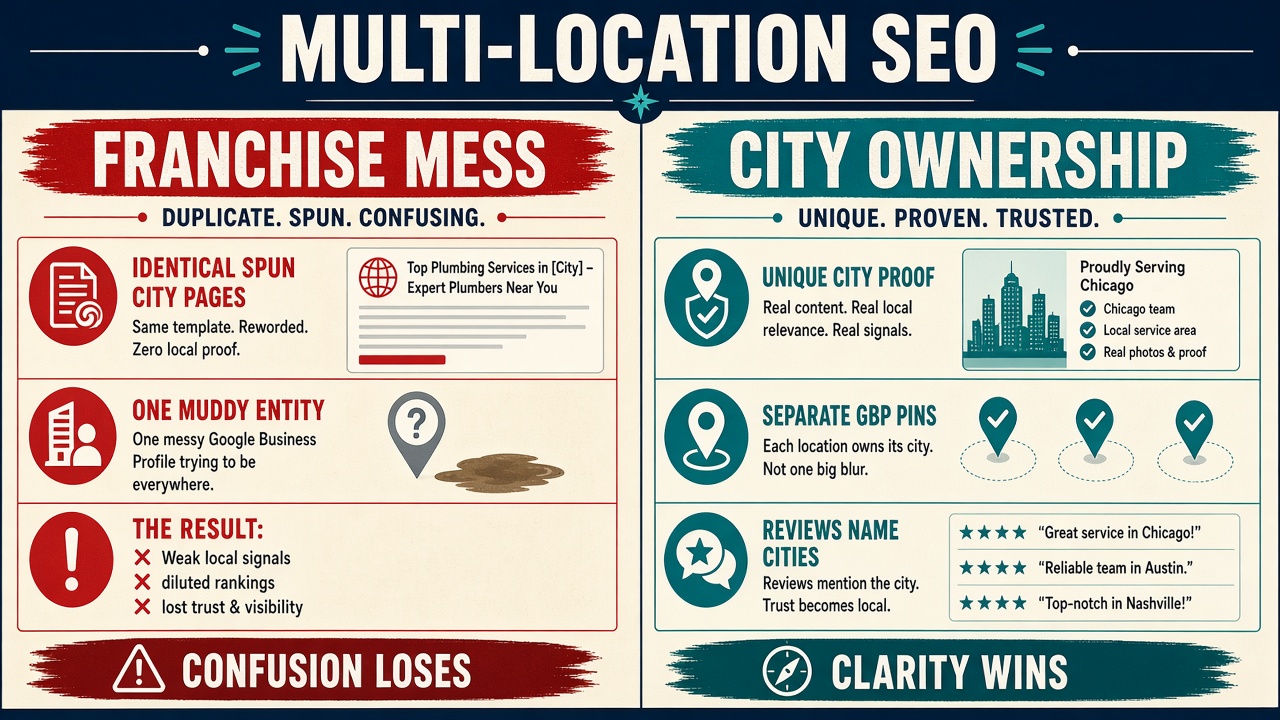
Call now and find out why your phone isn’t ringing.
Local Market Hooks: How Multi-Location Pain Shows Up City by City
Austin TX — Density Turns Weak Sister Pages Into Invisible Ones
Austin is a category war. Home services, specialty trades, multi-office professional firms—everyone wants Map Pack oxygen. If your Austin city page is a spun twin of your Nashville page, Austin will not gift you trust. (Our Austin local SEO guide covers what holds up here.) Google Business Profile multi-location discipline matters here because adjacent suburbs and “greater Austin” claims get scrutinized fast. Specificity wins. Vague multi-city brands lose to the operator who owns one corridor with undeniable proof—and then expands without diluting the entity.
Lakeway / Lake Travis — Hyper-Local Proof Beats Metro Theater
Lakeway and Lake Travis buyers are not impressed by a corporate “Austin metro” page that never shows work west of the core. Multi-location SEO in this corridor means the lake markets get their own proof: reviews naming Lakeway or Lake Travis, service-area honesty, and GBP/site corroboration that does not contradict where trucks actually roll. Metro theater is entity risk with a scenic ZIP code.
Buffalo NY — Consistency Across Locations Separates Operators from Actors
Buffalo and Western New York clusters punish chaos. Seasonal urgency, practical buyers, and tight trust cycles mean NAP contradictions between sister locations are lead poison. A multi-location brand that looks polished nationally but answers slowly locally will lose to a single-shop competitor with coherent signals. In Buffalo NY, city ownership looks like reliability codified—clean profiles, honest hours, review substance, and pages that do not read like franchise spam shipped from somewhere else.
Nashville — Fast Markets Reward Summarizable Locations
Nashville moves. Review themes, neighborhood proof, and clear service definitions become citation fuel for ChatGPT / Gemini local recommendations. Multi-location brands that dump identical city pages across Middle Tennessee create the exact fog AI systems avoid. Rank without being summarizable and your phones go quiet while the corporate dashboard stays optimistic. Dual-visibility per location is not optional in Nashville. It is who gets named when someone asks who to call tonight.
Lexington KY — Tight Budgets Make Dilution Expensive
Lexington markets punish wasted spend. If you are renting attention with ads while sister locations cannibalize organic trust, you are funding someone else’s education. Multi-location SEO here often means fewer, stronger city assets—not more URLs. Entity hygiene, service clarity, and a conversion path that routes to the location that can fulfill the job separate operators from brochure brands pretending to “cover the region.”
Same disease across markets. Market-calibrated pressure. That is how Top Local Search Marketing executes multi-location SEO for service brands from Austin hubs to Buffalo / WNY clusters—and the corridors between.
AI Answer Block — Should every city we serve get its own page and GBP?
Only cities and locations you can prove. Real storefronts or qualifying locations deserve proper Google Business Profile multi-location treatment. City pages need unique proof—not spun coverage of every town on a map. Claiming everywhere without evidence creates entity dilution. Own what you can corroborate.
The Anti-Checklist: What to Stop Doing Immediately
- Publishing spun city pages with find-and-replace metro names
- Treating “more locations” as an automatic lead multiplier
- Forcing one corporate NAP onto every city page when locations differ in reality
- Letting duplicate or conflicting GBPs fight sister stores
- Keyword-stuffing location business names like a 2014 franchise hack
- Routing all reviews to a corporate soup that erases city proof
- Buying fake local citations or doorway networks “for scale”
- Measuring success with sitewide sessions while location phones stay quiet
- Assuming ChatGPT will recommend you because your sitemap is long
- Expanding into a new city without anti-cannibalization rules and a clear one-client-per-market rule
Activity reports feel like growth. City ownership pays the payroll.
How This Fits Our Work
Multi-location SEO is not a silo and it is not a franchise module you bolt on after “regular SEO.” At Top Local Search Marketing we connect Google Business Profile multi-location hygiene, city-page architecture, schema corroboration, review substance, anti-cannibalization routing, and conversion—so service brands stop funding footprint theater.
We call out industry noise because the noise is expensive. “Blast city pages.” “One NAP to rule them all.” “ChatGPT will catch up.” That is not a system. That is franchise mess sold by the hour.
Hormozi clarity: increase the likelihood each city page is the obvious local choice, decrease the friction to call the right location, and stop making the machine guess. Urgency: attention is scarce and demand today is finite. Ziglar flair: you can still own the room—belief plus a system beats resignation. The competitor who installs clean city ownership first gets compounding trust across Map Pack and AI recommendations. You do not need another template. You need entities the machine can defend.
Hard CTA: Stop Funding Franchise Mess. Own the Cities That Pay.
Want a multi-location Market Audit that shows which locations are assets—and which are diluting your entity?
Get your call with our team from Top Local Search Marketing.
Call (512) 991-3840 or (512) 991-3840.
Email Info@TopLocalSearchMarketing.com.
We will tell you straight—which city pages are proof, which are spam-adjacent, which GBPs are fighting each other, and how to build dual-visibility so Google and ChatGPT trust the location that should win the call. One client per market for markets worth owning. Not another franchise-style content farm.
If your Business is not on the Search Engine’s first page—including map—for the cities you serve, you are missing out on business. Worse: your competitors are getting new business every day.
FAQ: Multi-Location SEO for Service Brands
Q1: What is multi-location SEO in plain English?
It is making each real location or distinct service city a trustworthy local entity—GBP where appropriate, unique city pages, schema, reviews, and routing—so searchers and AI systems pick the right store without confusing your brand for a template farm.
Q2: Do we need a separate Google Business Profile for every city on our site?
No. You need accurate Google Business Profile multi-location coverage for real, qualifying locations. City pages without a storefront still need proof—but inventing GBPs for towns you do not operate from is a compliance and trust problem, not a growth strategy.
Q3: Why does ChatGPT recommend a smaller competitor instead of our bigger footprint?
Because recommendation engines prefer verifiable clarity over corporate girth. One clean entity with city-named reviews and coherent NAP often beats twenty thin city pages that dilute confidence. Footprint is not the same as machine trust.
Q4: Is “one NAP everywhere” wrong?
Blindly pasting one NAP on every city surface can be wrong when you have multiple real locations. Consistency per location is mandatory. Pretending multiple stores share one identity when they do not creates entity risk. Service-area businesses need honest architecture—not fake address theater.
Q5: How do we stop sister locations from cannibalizing each other?
Triage ownership of geos and money queries, clean GBP boundaries, differentiate city proof, fix internal linking and landing paths, and measure by location. Anti-cannibalization is part of the TLSM system—not an afterthought spreadsheet.
Q6: Will fixing multi-location SEO help AI Overviews and Gemini too?
Usually yes. Coherent per-city entities strengthen Map Pack surfaces and make ChatGPT / Gemini local recommendations safer. Dual-visibility is the point. Thin franchise mess helps neither surface.
Q7: How fast can multi-location cleanup show up in calls?
Hygiene fixes—duplicate suppression, phone routing, category precision, killing the worst spun pages—can change behavior relatively quickly. Deeper proof density, review substance, and trust compounding take longer. Anyone promising overnight domination across ten cities is selling fantasy. We will not.
Q8: Why mention one client per market here?
Because diluted markets create weak operators. When a niche in a market is worth owning, we structure engagements so serious city ownership is protected—not shared across copycat footprints that train the machine to trust nobody. Ask about open territories in your category when you request your call with our team.
P.S. Those are real numbers—(512) 991-3840 and (512) 991-3840—answered by humans who will talk about your locations, your cannibalization, your city pages, and your phone logs without a scripted maze. Email Info@TopLocalSearchMarketing.com if you want the multi-location Market Audit on the calendar. If your footprint looks busy and your phones stay selective, the machine already decided. Fix the entity—or keep bleeding leads to the competitor with one clean city page. We only work with one business per market, and open markets do not stay open forever. Call. Own the cities that pay.
— Top Local Search Marketing | https://toplocalsearchmarketing.com | Info@TopLocalSearchMarketing.com
Stop funding franchise mess. Own the cities that pay.
If your multi-location footprint is busy online and quiet on the phone, the machine already decided. Fix the entity — or keep bleeding leads to the competitor with one clean city page.
(512) 991-3840
Call now and find out why your phone isn’t ringing.
Where this fits: Running several locations? See how we handle multi-location marketing for service brands, built on the same local SEO and Google Maps work we do for single shops.