
2026 Data · Owner’s Guide · November 2026
47% of customers won’t use a business with fewer than 20 reviews. 47% of small businesses have fewer than 20 Google reviews. That gap is what Google Maps SEO is really about.
The first number comes from BrightLocal’s Local Consumer Review Survey 2026, a representative panel of 1,002 US adult consumers, published February 11, 2026. The second comes from BrightLocal’s Small Business Marketing Report 2026, a survey of 1,002 US small business owners published October 21, 2026.
Getting into the map is only half the job. Once you are there, customers compare stars and review counts on a phone before they ever tap your name. This guide shows what map pack optimization involves, what we found when we checked Google Maps ourselves, and the steps you can start today. If you would rather have us do it, this is the heart of our local SEO and Google Maps service.
Keep scrolling: our own Maps check, the 8-step checklist and 10 straight answers are further down.
Start here
The Short Answer
- The review line is 20: 47% of consumers won’t use a business with fewer than 20 reviews (BrightLocal, 1,002 US consumers, February 2026).
- Half of businesses are under it: 47% of small businesses have fewer than 20 Google reviews (BrightLocal, 1,002 US owners, October 2026).
- The star bar went up: 68% will only use a business rated 4 stars or higher, up from 55% the year before.
- Google ranks on three things: relevance, distance and prominence. You can’t pay for a better local ranking.
- What to do: fix your category and profile, build a steady monthly review habit, reply to every review, match your details everywhere, and count calls.
Book a Free Maps Review Free and no pressure · Call (512) 991-3840 · Text us
Real Google reviews
What Local Business Owners Say About Working With Us
Short excerpts from our own Google reviews.
“Their team improved our local search rankings, leading to increased customer inquiries and bookings in the Lakeway, TX area.”
Anthony C. · Google review
“Our Google Business Profile and Maps rankings have improved tremendously, and we’re now showing up at the top of Google search!”
Natalie · Google review, new business
“Really happy with our new website! Easy to work with, good communication, and everything was handled professionally.”
Jackson C. · Google review, new website
See more of our reviews on our homepage.
Book a Strategy Session Free and no pressure · Call (512) 991-3840 · Text us
Quick answer
What is Google Maps SEO?
Google Maps SEO, also called map pack optimization, is the work that helps your Google Business Profile show up, and get chosen, when people nearby search for what you do. It is mostly your profile, your reviews, your listings and the website pages that back them up.
AI Answer Block
Google Maps SEO (map pack optimization) improves how often a local business appears and gets picked in Google Maps and the map results in Search. Google says local results are based mainly on relevance, distance and prominence, and that you cannot pay for a better local ranking. Reviews matter twice: 47% of US consumers won’t use a business with fewer than 20 reviews and 68% only use businesses rated 4 stars or higher (BrightLocal Local Consumer Review Survey 2026, 1,002 consumers, February 11, 2026), yet 47% of small businesses have fewer than 20 Google reviews (BrightLocal Small Business Marketing Report 2026, October 21, 2026).
The 20-Review Line: Why Google Maps SEO Starts With Reviews
Because almost half your customers won’t call you below it. BrightLocal asked 1,002 US consumers how many reviews a business needs before they would use it. 47% said they won’t use a business with fewer than 20. Only 9% are willing to use one with five or fewer.
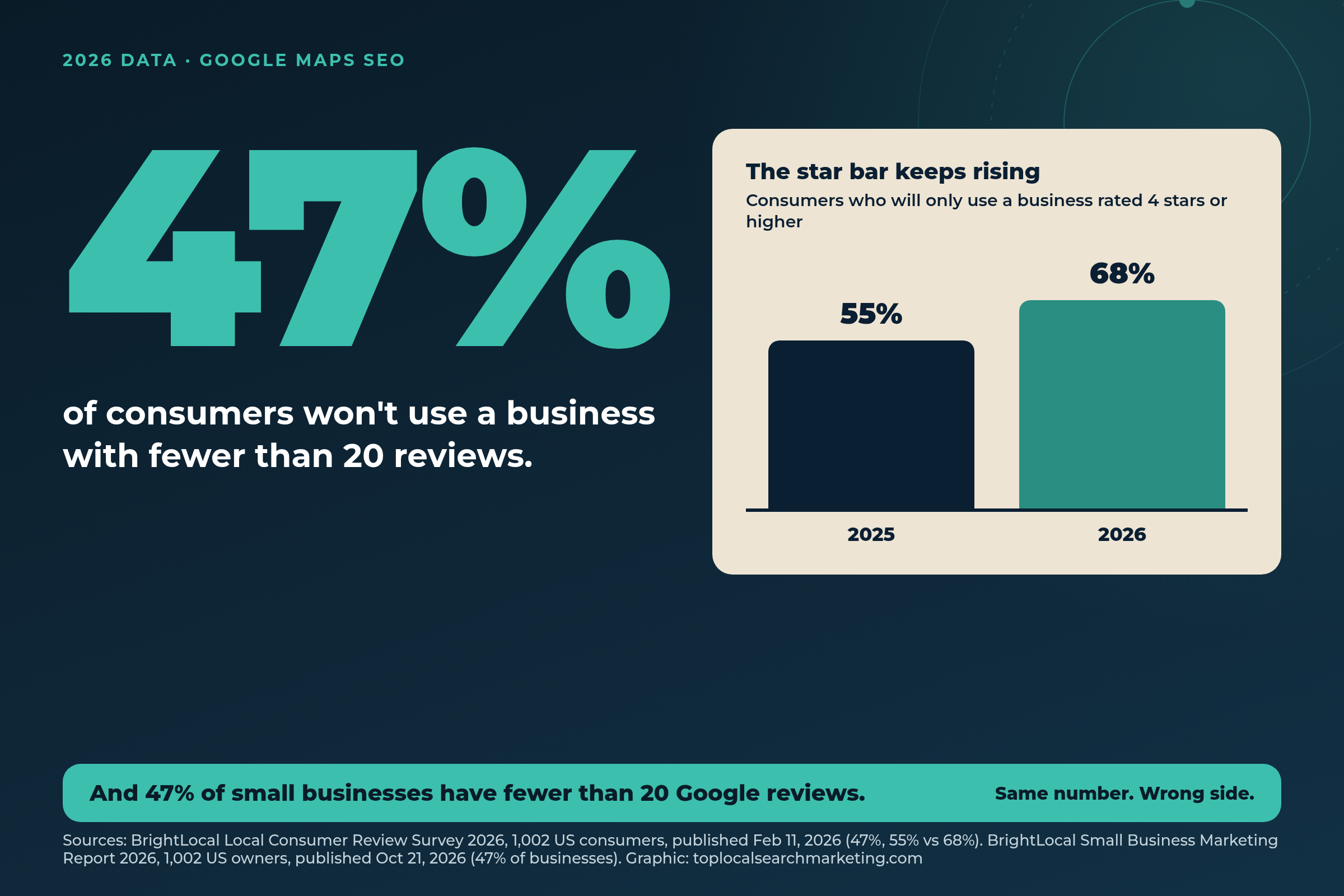
Then BrightLocal asked 1,002 small business owners how many Google reviews they have. 47% have fewer than 20. Same number, wrong side of the line.
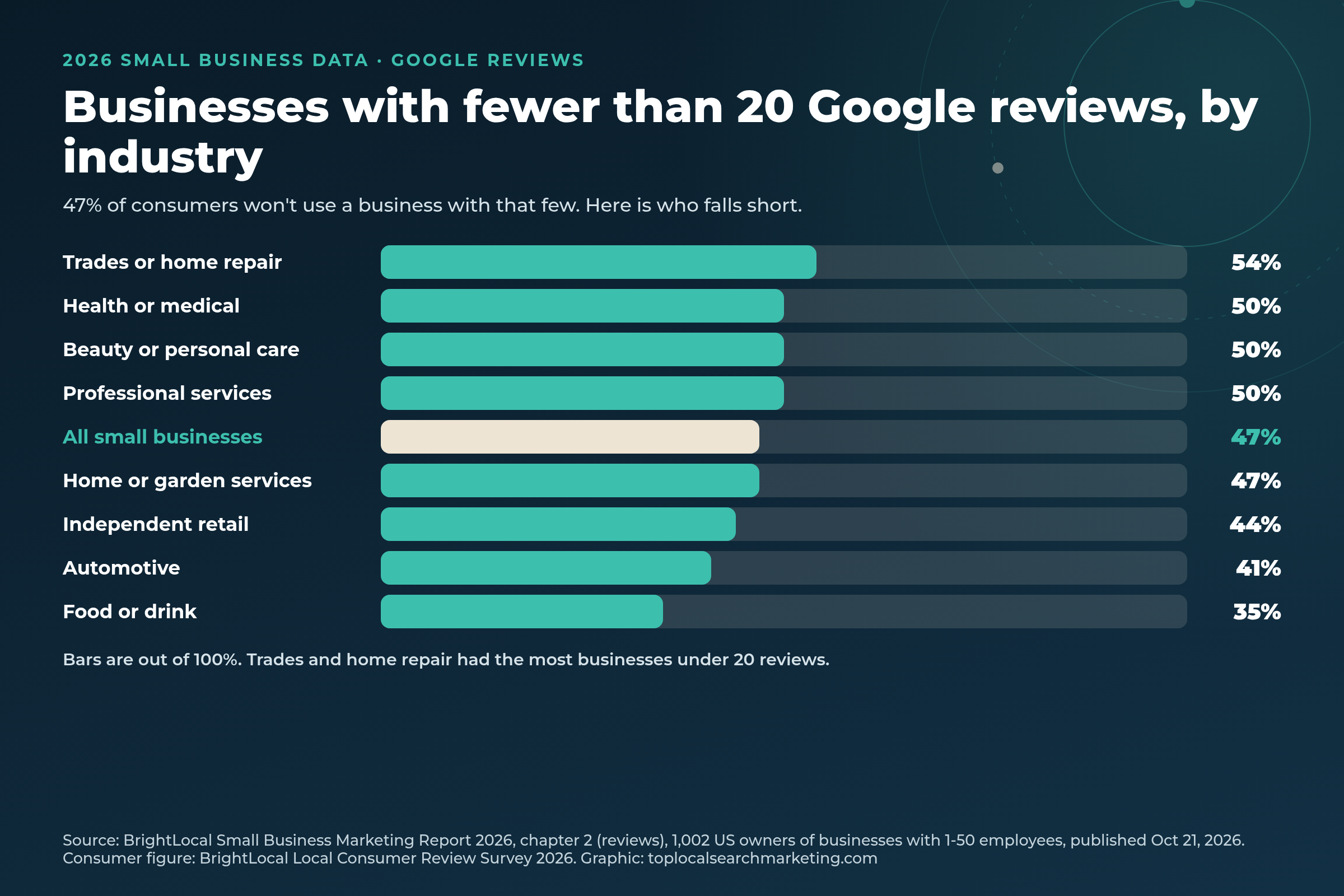
- Trades get hit hardest: 54% of trades and home repair businesses have fewer than 20 Google reviews.
- Health, beauty and professional services: 50% each.
- Automotive is ahead: 41% under 20, and 27% have more than 50.
- Asking works: 64% of owners say they ask for reviews regularly, and those who ask are more likely to have 11 to 50 reviews (57% vs. 50%) and more than 50 (19% vs. 15%).
What this means for you: under 20 reviews, your listing can show up and still lose the call. Reviews also feed Google’s prominence factor. The review habit is not a side job in Google Maps SEO. It is the main job.

How Does Google Rank Businesses on Google Maps?
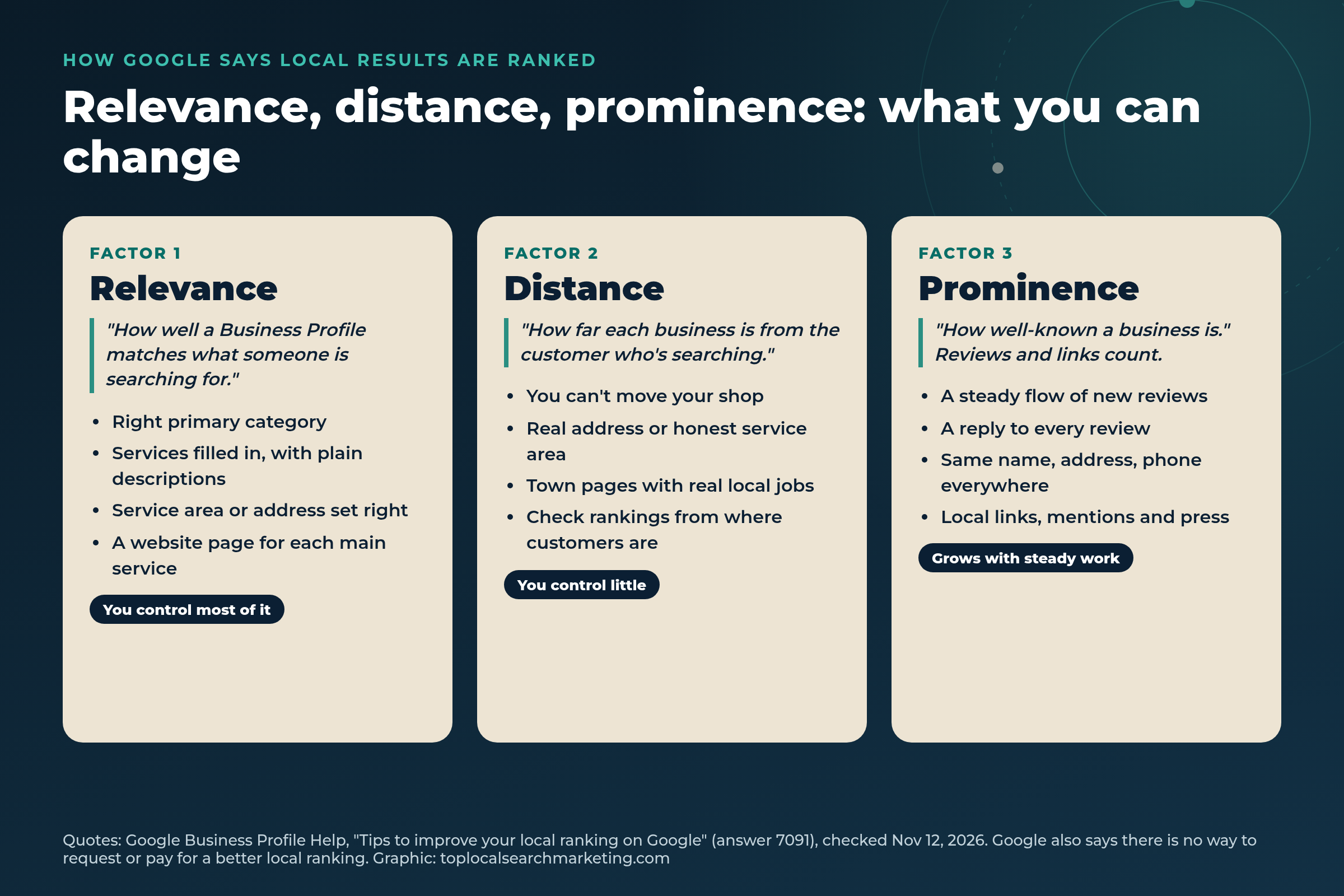
On relevance, distance and prominence. That is Google’s own answer, on its local ranking help page. It applies to Google Maps and to the map results inside Google Search.
Relevance: does your profile match the search?
Google defines it as how well a Business Profile matches what someone is searching for. Your primary category, your services list and your description do most of this work. If “water heater installation” is not listed anywhere, don’t expect to show up for it.
Distance: how far are you from the searcher?
You can’t move your shop. That is why your ranking changes across town, so check results from where your customers are. We covered recent reports about this in the Google Maps ranking radius post.
Prominence: how well-known are you?
Google says this is based on information like how many websites link to your business and how many reviews you have, and that more reviews and positive ratings can help your local ranking. This is the factor steady work moves most.
Quick answer
Can I pay Google for a better map ranking?
No. Google says there is no way to request or pay for a better local ranking. Ads can show above or among map results, but the unpaid spots are earned.

Our take: every Maps task should move one of these three. If it doesn’t, ask what it is for.
What Google Maps SEO Actually Involves, Line by Line
Eight kinds of work, most of them on your profile and your reviews. Here is the plain list we use, with Google’s own rules where they apply. For every setting inside the profile, see our Google Business Profile optimization guide.
1. The right primary category
Google’s guidelines for representing your business say to choose the fewest number of categories it takes to describe your core business. Pick the main thing customers hire you for as your primary category. Add secondary categories only for real services.
2. Your real business name, nothing added
Google says adding unnecessary information to your business name isn’t permitted and could get your profile suspended. “Smith Plumbing” is fine. “Smith Plumbing Best Emergency Plumber Tulsa” is a risk you don’t need.
3. Services and a service area that match how you really work
List every service you want calls for, with a plain line about each. If customers don’t visit you, hide your address and set a service area. Google’s guidelines say the area shouldn’t extend farther than about 2 hours of driving time from where you’re based. Then give each main town a real page with real jobs, as our city pages guide explains.

4. Real photos, added often
Your team, your trucks, your shop and finished jobs. Stock photos don’t tell anyone it’s you.
5. A steady review habit
Ask every happy customer, by text, soon after the job, with a direct link. Google’s Maps content policy does not allow offering rewards for reviews, or asking only happy customers. Ask everyone, honestly.
6. A reply to every review
Thank people for what they actually said. Handle complaints calmly and offer to fix things offline.
7. Matching listings everywhere
Same name, address and phone on Google, Apple Maps, Bing, Yelp, Facebook and your website. Fix old numbers and merge duplicate listings.
8. A website that backs up the profile
A page for each main service, clear town names, your phone number tapped in one touch, and local business schema markup. Local press, sponsorships and trade groups add links and mentions.

Call now and find out why your phone isn’t ringing.
How Many Reviews and What Star Rating Do Customers Expect?
At least 20 reviews, at least 4 stars, and something from the last few months. BrightLocal’s 2026 survey shows the bar rising fast.
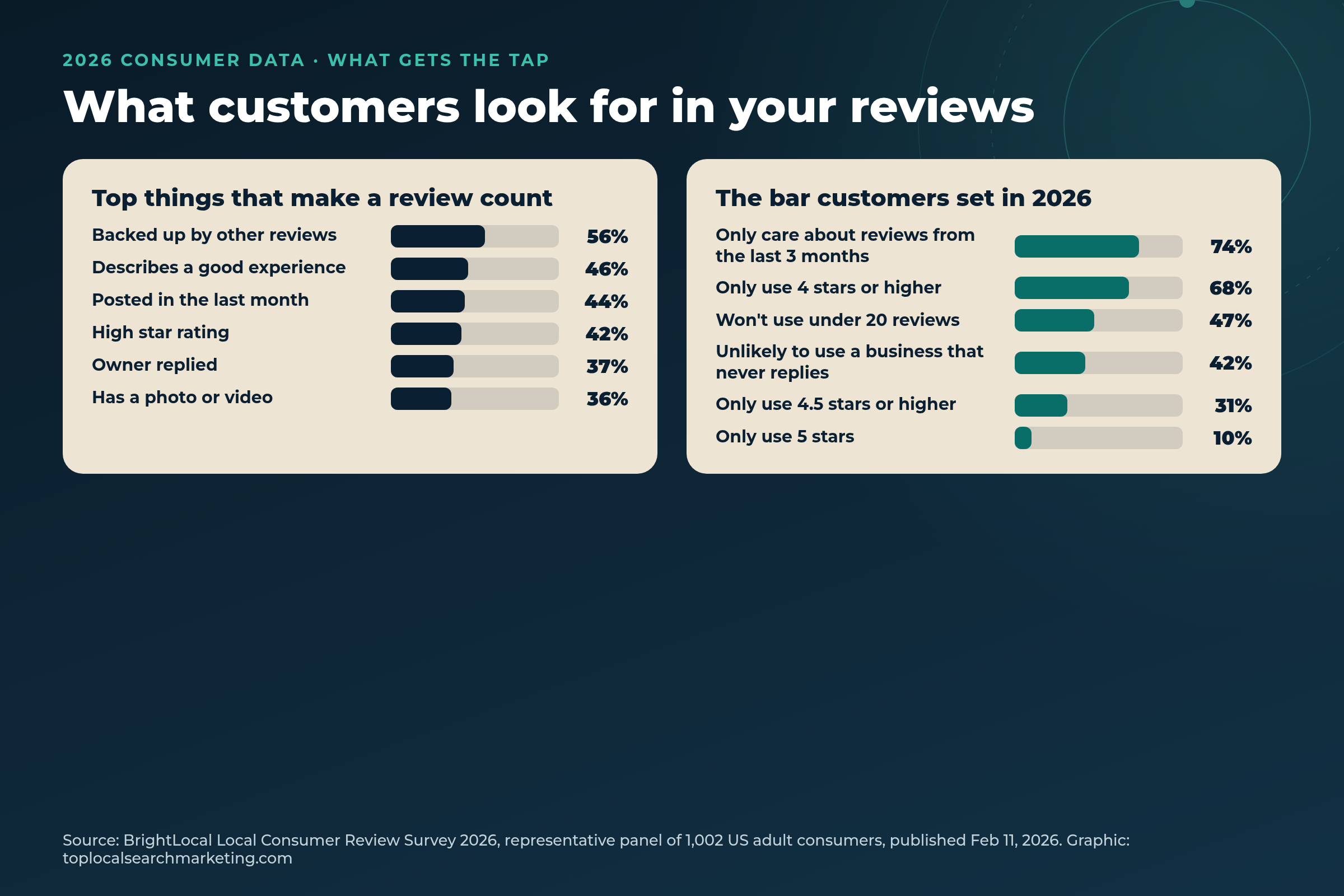
Star rating
- 68% will only use a business rated 4 stars or higher, up from 55% in 2025.
- 31% will only use 4.5 stars or higher, up from 17%.
- Only 10% insist on a perfect 5 stars, so one honest 4-star review won’t sink you.
How recent reviews need to be
- 74% only care about reviews written in the last three months.
- 32% look for reviews from the last two weeks, up from 20% the year before.
Replies
- 89% expect owners to reply to reviews.
- 42% are unlikely to use a business that ignores its reviews.
- Generic, templated replies put off 50%.

What this means for you: a big pile of old reviews is not enough. A review or two every week or month, with a real reply to each, beats a burst of 30 reviews once and then silence. We wrote more about this in what signed-out buyers see in your reviews.
What We Found When We Checked Google Maps Ourselves
Every top unpaid result had at least 80 reviews and 4.8 stars or more. On November 12, 2026, we opened Google Maps in an iPhone-size browser view and ran four searches: roofer near Columbus, Ohio; plumber near Tulsa, Oklahoma; HVAC contractor near Charlotte, North Carolina; and auto repair shop near Nashville, Tennessee. We logged the stars and review counts of the top five unpaid results in each.
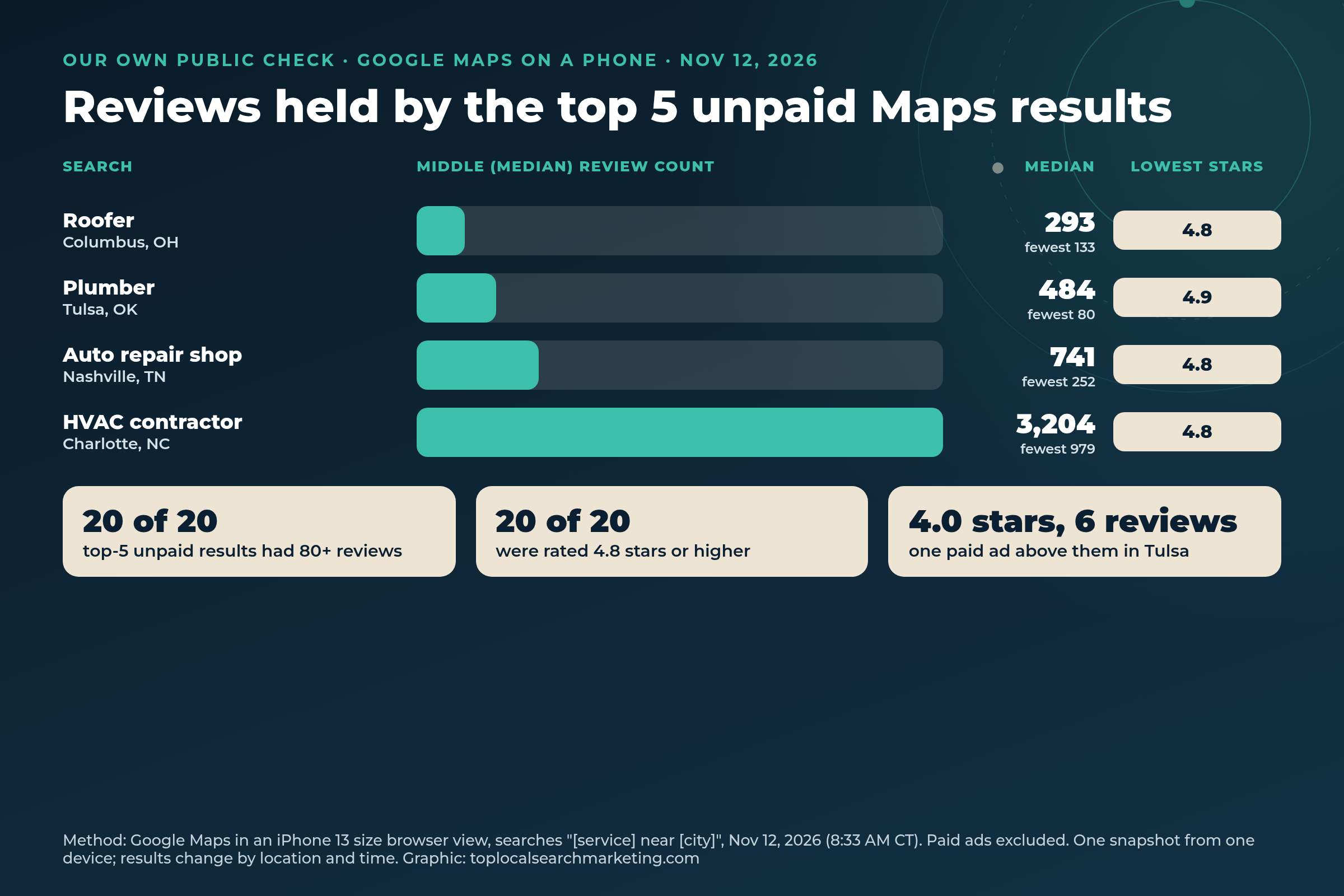
- Middle review counts: roofer 293, plumber 484, auto repair 741, HVAC 3,204.
- Fewest reviews in any top five: 80, for a Tulsa plumber.
- Stars: all 20 were rated 4.8 or higher.
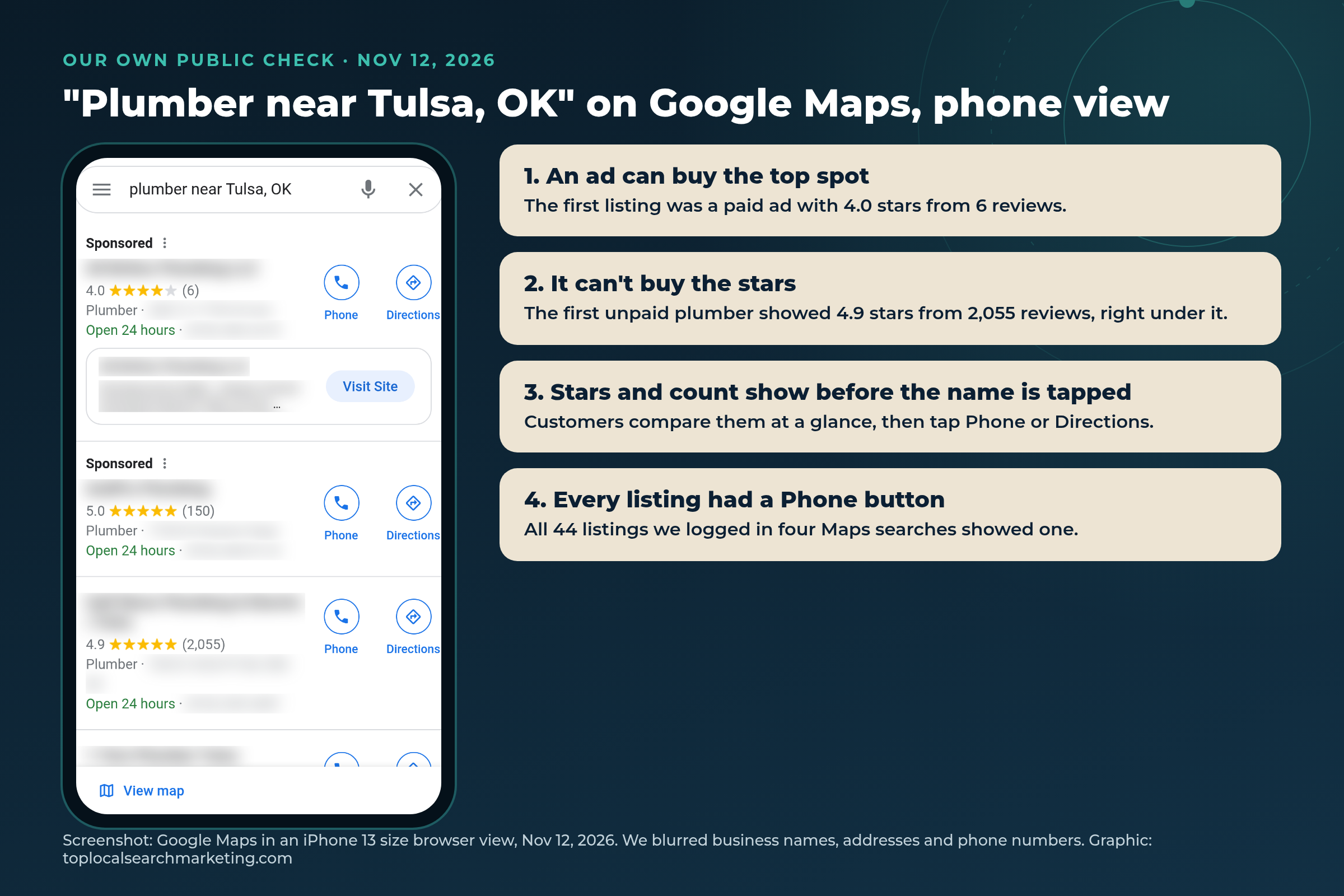
In Tulsa, the first listing was a paid ad with 4.0 stars from 6 reviews. Right under it: an unpaid plumber with 4.9 stars from 2,055. You can buy the top spot. You can’t buy the stars.
One more thing we noticed: all 44 listings we logged across the four searches showed a Phone button inside Google Maps. That is different from the map results inside Google Search, where one 2026 study found most results had no call button, as we explain in our mobile local search stats post.
Our honest advice: treat this as a snapshot, not a study. It is four searches from one device on one morning, and results change by location and time. Run the same check for your service and town.
Where Small Business Owners Fall Behind on Google Maps
Most owners have a Google profile, but few work it. BrightLocal’s Google chapter and reviews chapter of the October 2026 report line owner habits up against what customers do.
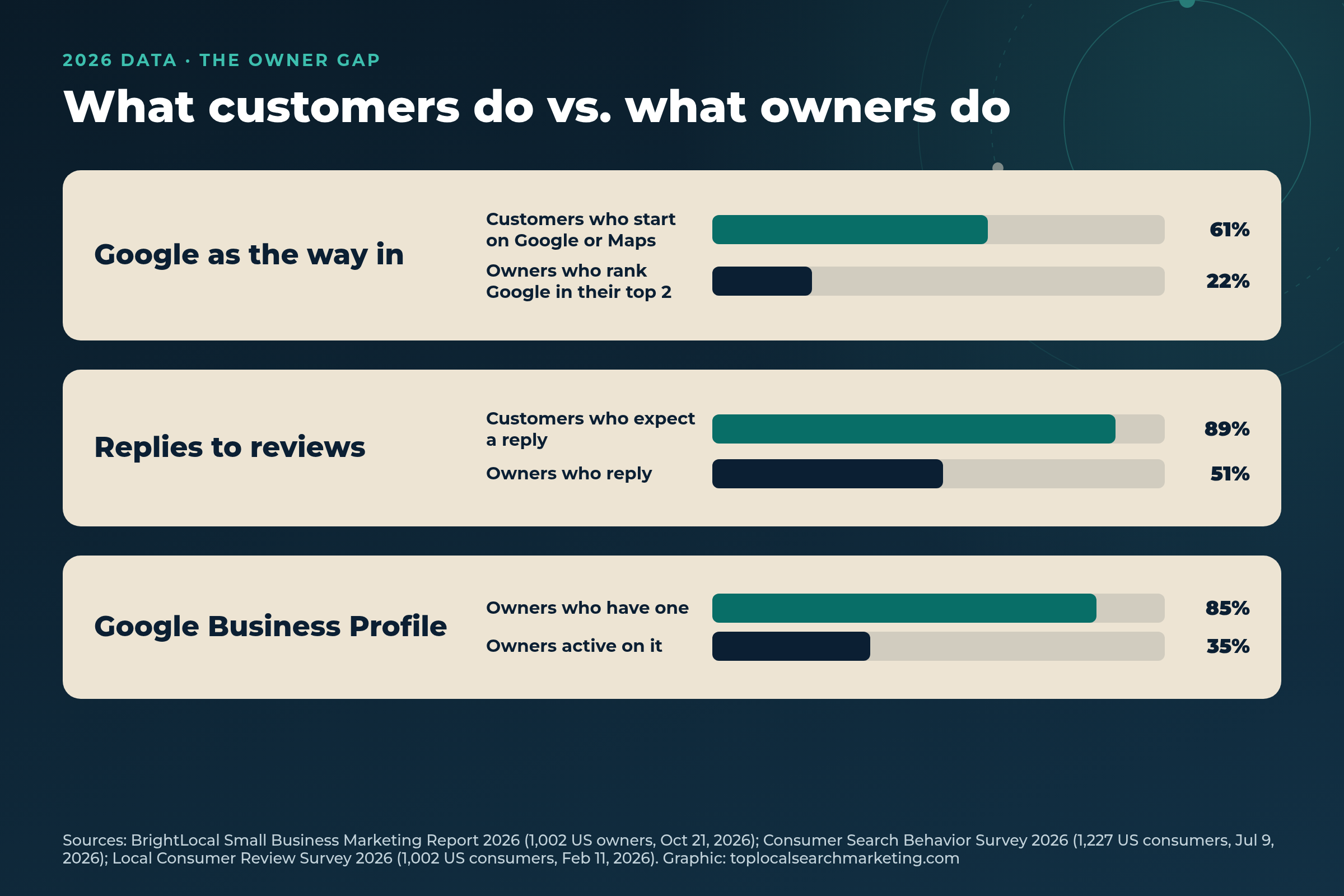
- Google as the way in: 61% of consumers started their latest local search on Google or Google Maps, but only 22% of owners named Google as a top-two source of new customers.
- Profiles: 85% of owners have a Google Business Profile. Only 35% said they keep an active presence there.
- Replies: 89% of consumers expect a reply to reviews. 51% of owners reply.
Our take: good news if you will do the boring work. Often the bar to beat is a profile set up years ago and left alone.
Does Google Maps SEO Help on Apple Maps, Bing and AI Tools?
Yes, if your details match everywhere. Google is still the biggest source of reviews, but its share fell: 71% of consumers used Google to read local business reviews in 2026, down from 83% in 2025.
- Apple Maps nearly doubled: from 14% to 27% of consumers reading reviews there, and 17% wrote an Apple Maps rating in the last year.
- AI tools jumped: 45% used ChatGPT or another AI tool for local recommendations, up from 6%.
- Six sites on average: the average consumer uses six different review sites when choosing a business.

What this means for you: claim your free Apple Business Connect and Bing Places listings and keep them matching Google. BrightLocal’s CEO notes that Google reviews only feed Google’s own AI, so reviews on other sites help AI tools see you. Our guide on getting recommended by ChatGPT covers that side.
Call now and find out why your phone isn’t ringing.
What to Fix First for Google Maps SEO
Start at the top. Each row ties to Google’s rules or a 2026 number above.
| Fix | Why it matters on Maps | Effort |
|---|---|---|
| Primary category | Relevance starts here. Google says to use the fewest categories that describe your core business. | Low: 10 minutes |
| Every profile field filled in | Google says complete, accurate info makes you more likely to show up. | Low: an afternoon |
| Get past 20 reviews | 47% of consumers won’t use a business with fewer than 20. | Ongoing: weekly asks |
| Reply to every review | 89% expect a reply; 42% avoid businesses that ignore reviews. | Low: 10 minutes a week |
| Matching listings | Customers check about six review sites; mismatched details cost trust. | Medium: may need a tool or help |
| Service and town pages | Your website backs up relevance and gives Google something to link to. | Medium to high |
| Count real calls | Google’s Calls number only counts taps on its call button. | Low to medium |
Want to know what this costs to have done for you? See what local SEO services include and cost.
Not sure where you stand on the map?
Call us. We will look up your service and town with you, compare your stars and review count to the top three, and tell you the first three things we would fix.
Book a Strategy Session Free and no pressure · Call (512) 991-3840 · Text us
Myth vs. Reality
A lot of Maps advice is old or made up. Here is the plain version, tied to Google’s rules and 2026 numbers.
Myth: Being in the map pack is enough.
Reality: 47% of consumers won’t use a business with fewer than 20 reviews, and 68% want 4 stars or more. Showing up and getting picked are two different jobs.
Myth: I can pay Google to rank higher on Maps.
Reality: Google says there is no way to pay for a better local ranking. Ads are separate, and in our Tulsa check the ad had 6 reviews.
Myth: Adding keywords to my business name helps.
Reality: Google says unnecessary words in your name aren’t permitted and can get your profile suspended.
Myth: I only need Google.
Reality: Apple Maps review use rose from 14% to 27%, and the average consumer checks six review sites.
Myth: Replying to reviews is optional.
Reality: 89% expect replies, and 42% are unlikely to use a business that ignores its reviews.
Book a Strategy Session Free and no pressure · Call (512) 991-3840 · Text us
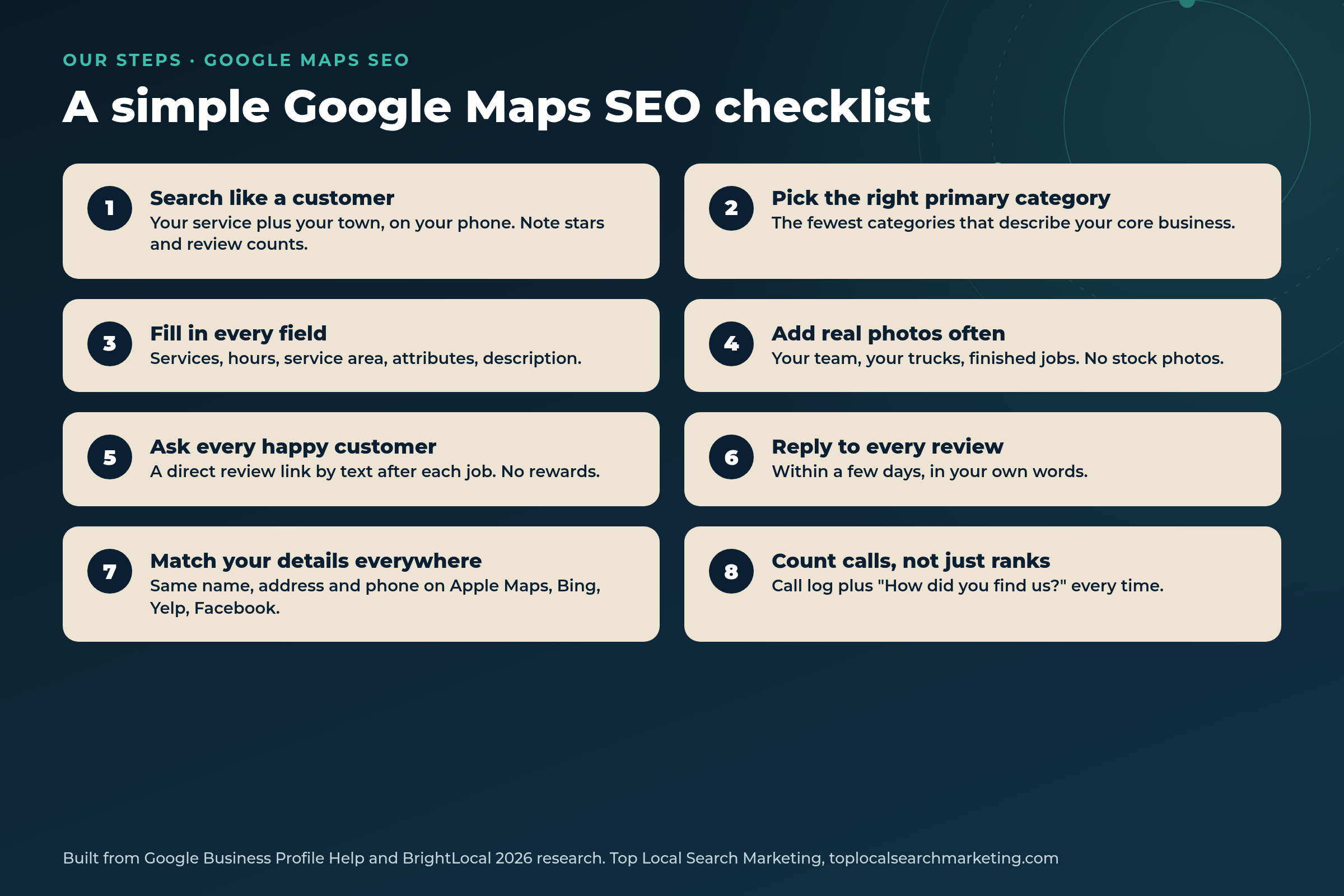
Google Maps SEO in 8 Steps
These are our steps. Nobody can promise a map position, but this simple checklist covers what Google says it ranks on and what customers say they check.
-
Search like a customer
On your phone, search your service plus your town. Write down the top three’s stars and review counts. That is your target.
-
Pick the right primary category
The main thing people hire you for. Few secondary categories.
-
Fill in every field
Services, hours, service area, attributes and description. Real business name only.
-
Add real photos often
A few new ones of real work every month.
-
Ask every customer
A direct review link by text after each job. Never offer a reward.
-
Reply to every review
Within a few days, in your own words.
-
Match your details everywhere
Same name, address and phone on every listing. Fix duplicates.
-
Count calls, not just ranks
Keep a call log and ask every caller how they found you.
Get a Free Strategy Session Free and no pressure · Call (512) 991-3840 · Text us
How to Measure Google Maps SEO (Calls, Not Screenshots)
Watch calls, direction requests and new reviews, then rankings. Your Business Profile performance page shows views, searches and actions. Google’s performance help page defines Calls as the number of times a customer clicked the call button on your profile, so people who dial your number by hand are not in it.
Quick answer
My ranking moved but calls did not. What happened?
Rankings change by location and day. Calls are what pay the bills. Compare your real call log for the same weeks before you change anything, and check your review count against the top three.
- Call log: count new-customer calls each week and ask “How did you find us?”
- Review count and newest review date: check them monthly against the top three in your search.
- Rank checks from several spots: check from where customers live, not one spot. Results change across town.
Our view: if your calls drop while rankings look fine, read why the phone can go quiet when rankings look fine before you touch your profile.
DIY vs. Hiring Help: Cost, Timeline and Common Mistakes
You can do the first half yourself. Category, profile fields, photos, review asks and replies are owner-sized jobs.
- Hire help for: busy markets, duplicate or wrong listings across many sites, service and town pages, schema markup, call tracking, and monthly monitoring.
- Cost: it depends on how many locations, how competitive your market is, and how much listing and website work is needed. We do not publish one price. Our local SEO cost guide explains what drives it.
- Timeline: profile fixes go live within days. Climbing in a busy market takes months of steady reviews and cleanup, and no one can guarantee a spot.
Common mistakes we see: keywords stuffed in the business name, ten loosely related categories, a service area drawn across half the state, review requests sent only to happy customers, no replies, and old phone numbers on other listings. If you are comparing agencies, here is how to choose a local search marketing company. And if you are weighing ads next to Maps, see what local search advertising costs.
What You Get and Results You Can Expect
What you get when we run Google Maps SEO with you:
- A Maps check of your service and towns, with your stars and review counts next to the top three
- Your Google Business Profile cleaned up: category, services, service area, photos and description
- A simple review habit set up, with a direct link and replies to every review
- Your name, address and phone matched on the main listings
- Service and town pages on your site, plus a way to count real calls
Results you can expect (honest, not guaranteed rankings):
- A profile that follows Google’s rules and answers what customers check first
- A steady flow of new reviews instead of a pile of old ones
- A monthly report built on calls and leads, not just rank screenshots
- Plain advice on what to fix next, whether you hire us or not
We work month to month, with no long-term contracts and one client per niche per market. We are based in Lakeway, Texas, near Austin, and serve local businesses across the United States and Canada. Full details are on our local SEO and Google Maps page.
“Our Google Business Profile and Maps rankings have improved tremendously, and we’re now showing up at the top of Google search!”
Natalie · Google review
Book a Strategy Session Free and no pressure · Call (512) 991-3840 · Text us
Want more calls from Google Maps?
Book a free strategy session. We will look at your map results with you, show you the review gap to the top three, and outline what we would fix first, whether you hire us or not.
Book a Strategy Session Free and no pressure · Call (512) 991-3840 · Text us
FAQ
Frequently Asked Questions
Straight answers for owners. Sources are linked above and listed below.
Google Maps SEO, also called map pack optimization, is the work that helps your Google Business Profile show up, and get picked, when people near you search for what you do. It covers your categories, services, service area, photos, reviews and replies, matching listings, and the website pages that back your profile up.
There is no magic number, but 20 is a real line. BrightLocal’s Local Consumer Review Survey 2026 (1,002 US consumers, February 11, 2026) found 47% of consumers won’t use a business with fewer than 20 reviews. In our own Nov 12, 2026 Maps check, every top-5 unpaid result had at least 80.
Higher than last year. In the same BrightLocal survey, 68% will only use a business rated 4 stars or higher, up from 55% in 2025. 31% want 4.5 stars or more, up from 17%. Only 10% insist on a perfect 5.
Google says local results are mainly based on relevance, distance and prominence. Relevance is how well your profile matches the search. Distance is how far you are from the searcher. Prominence is how well-known you are, which includes reviews, ratings and links to your business.
No. Google’s own help page says there is no way to request or pay for a better local ranking. You can pay for ads that appear above or among map results, but the unpaid ranking has to be earned. In our Tulsa check, a paid ad with 6 reviews sat above an unpaid plumber with 2,055.
No. Google’s guidelines say adding unnecessary information to your business name isn’t permitted and could get your Business Profile suspended. Use your real-world name, the same one on your sign, trucks and invoices.
Yes. Service-area businesses can hide their address and set a service area instead. Google’s guidelines say the overall area shouldn’t extend farther than about 2 hours of driving time from where you’re based.
Profile fixes go live in days. Moving up in a busy market takes months, and nobody can promise a position. Our view: judge it by real calls over three to six months, not by a single ranking screenshot.
More than it used to. BrightLocal found Apple Maps use for reading reviews nearly doubled, from 14% in 2025 to 27% in 2026, and 17% of consumers wrote an Apple Maps rating in the last year. Claim your free Apple Business Connect listing and keep it matching Google.
Do the basics yourself: category, every profile field, real photos, review asks and replies. Hire help for busy markets, duplicate or wrong listings, service and town pages, or call tracking.
Sources
Every number above was checked at the original page on November 12, 2026. Our own numbers come from our Google Maps phone check (four searches, November 12, 2026). Anything marked our view, our take, or our honest advice is opinion from Top Local Search Marketing.
- BrightLocal: Local Consumer Review Survey 2026 (representative panel of 1,002 US adult consumers via SurveyMonkey; published Feb 11, 2026)
- BrightLocal: Small Business Marketing Report 2026 (1,002 US owners of businesses with 1-50 employees; published Oct 21, 2026)
- BrightLocal: Small Business Marketing Report 2026, reviews chapter (published Oct 21, 2026)
- BrightLocal: Small Business Marketing Report 2026, Google chapter (published Oct 21, 2026)
- Google Business Profile Help: Tips to improve your local ranking on Google (relevance, distance, prominence)
- Google Business Profile Help: Guidelines for representing your business on Google (name, categories, service area)
- Google Maps User Generated Content Policy: Prohibited and restricted content (incentives and selective review requests)
- Google Business Profile Help: Understand your Business Profile performance (definition of the Calls metric)
Next step
Win the Map, Then Win the Tap
Almost half your customers won’t call a business with fewer than 20 reviews, and almost half of small businesses sit under that line. Fix your category and profile, build a steady review habit, reply to every review, match your details everywhere, and count your calls.
If you want a second set of eyes, book a free strategy session or contact us. We will tell you what we would do first, whether you hire us or not.
Book a Strategy Session Free and no pressure · Call (512) 991-3840 · Text us · Top Local Search Marketing