

2026 Data · Owner’s Guide · November 2026
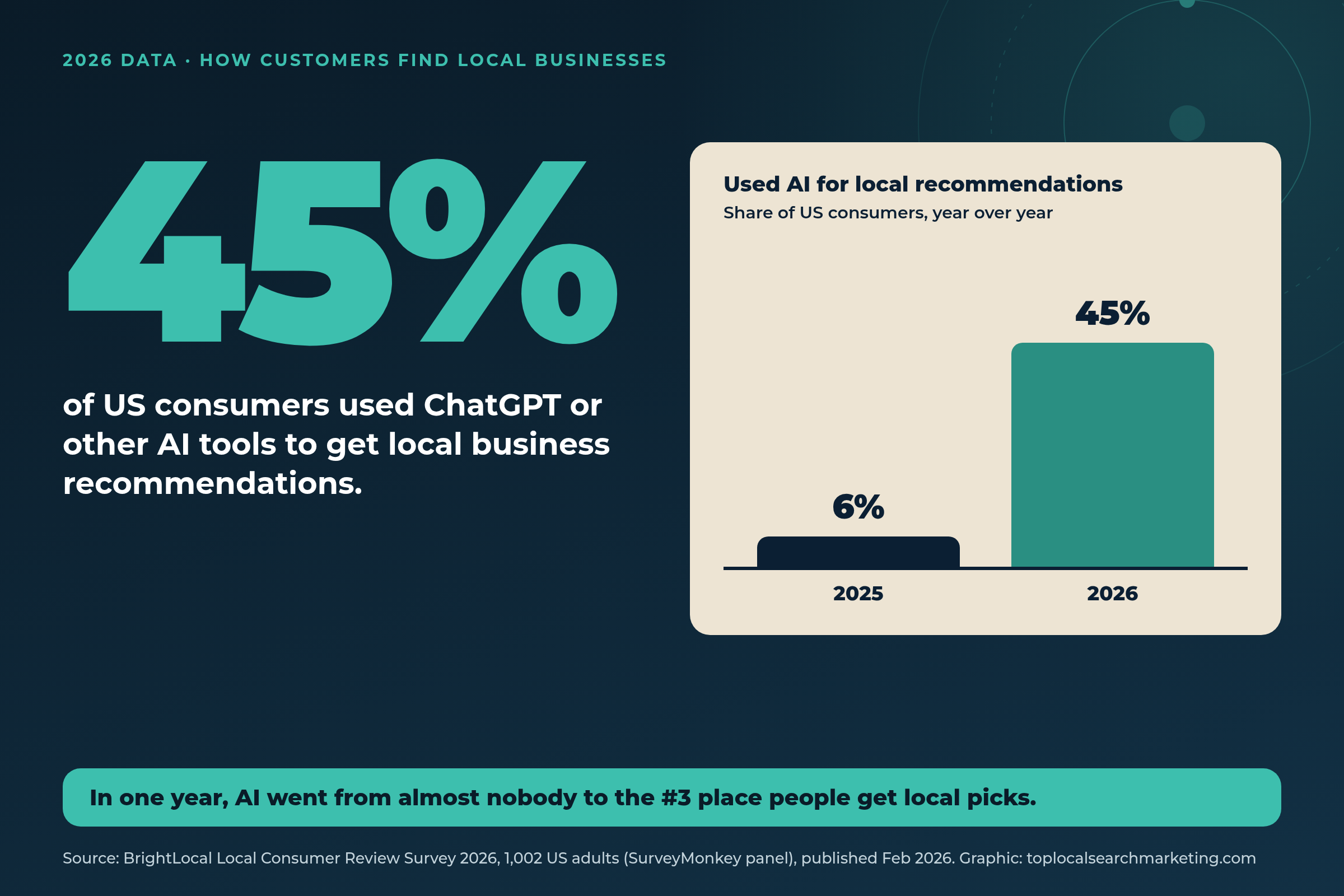
Last year, 6% of US consumers asked ChatGPT or another AI tool to recommend a local business. This year it is 45%.
That number comes from BrightLocal’s Local Consumer Review Survey 2026, a panel of 1,002 US adults. In one year, AI went from a rounding error to the third most popular place people get local business recommendations. Your next customer may never type “plumber near me.” They will ask a question, and an AI will hand them three or four names. If you want help being one of them, that is what our local SEO and Google Maps service is built for.
Here is the good news: AI does not pull names out of thin air. It reads your website, your listings and your reviews. This guide shows what the 2026 data says about where it looks, why the list keeps changing, what we found when we checked 30 big local brands, and the steps to get your business recommended by ChatGPT and Google’s AI.
Start here
The Short Answer
- How many people do this: 45% of US consumers used ChatGPT or other AI tools for local recommendations in 2026, up from 6% (BrightLocal, 1,002 adults).
- How ChatGPT picks: it turns the question into web searches, reads sources like business websites, Yelp and Bing, and names a few businesses. OpenAI says placement is not guaranteed.
- What you control: crawler access, a clear website, complete listings on Google, Yelp and Bing, and fresh reviews on more than one site.
- How to check: ask the same customer questions, with your city, a few times a month, and write down who gets named.
Book a Strategy Session Free and no pressure · Call (512) 991-3840 · Text us
Quick answer
Can you get your business recommended by ChatGPT?
Yes, but you cannot buy it or sign up for it. ChatGPT names businesses it finds in sources it trusts, like your website, Yelp, Bing and review sites. Make those sources clear, complete and current, and do not block OpenAI’s search crawler.
How Many People Use AI to Find Local Businesses?
45% of US consumers used ChatGPT or other generative AI tools for local business recommendations in the past year, up from 6% the year before. That is from BrightLocal’s Local Consumer Review Survey 2026, a representative panel of 1,002 US adults surveyed through SurveyMonkey and published in February 2026. BrightLocal says that made AI the third most popular source of business recommendations.
BrightLocal’s follow-up AI trust report (March 2026) breaks it down further:
- ChatGPT leads. 31% of consumers used it for business recommendations in the last 12 months. Google’s AI Mode came next at 23%.
- Age matters, but not how you think. 64% of adults aged 30 to 44 asked AI for a business recommendation in the past year. Even among people over 60, it was 24%.
What this means for an owner: the 30-to-44 crowd is buying homes, fixing roofs, booking dinners and finding a new mechanic. A big share of them now start with a question to an AI, not a search box.
Where else are people looking?
The same survey tracks every place people check. Google is still on top, but it slipped. AI tools grew faster than anything else.
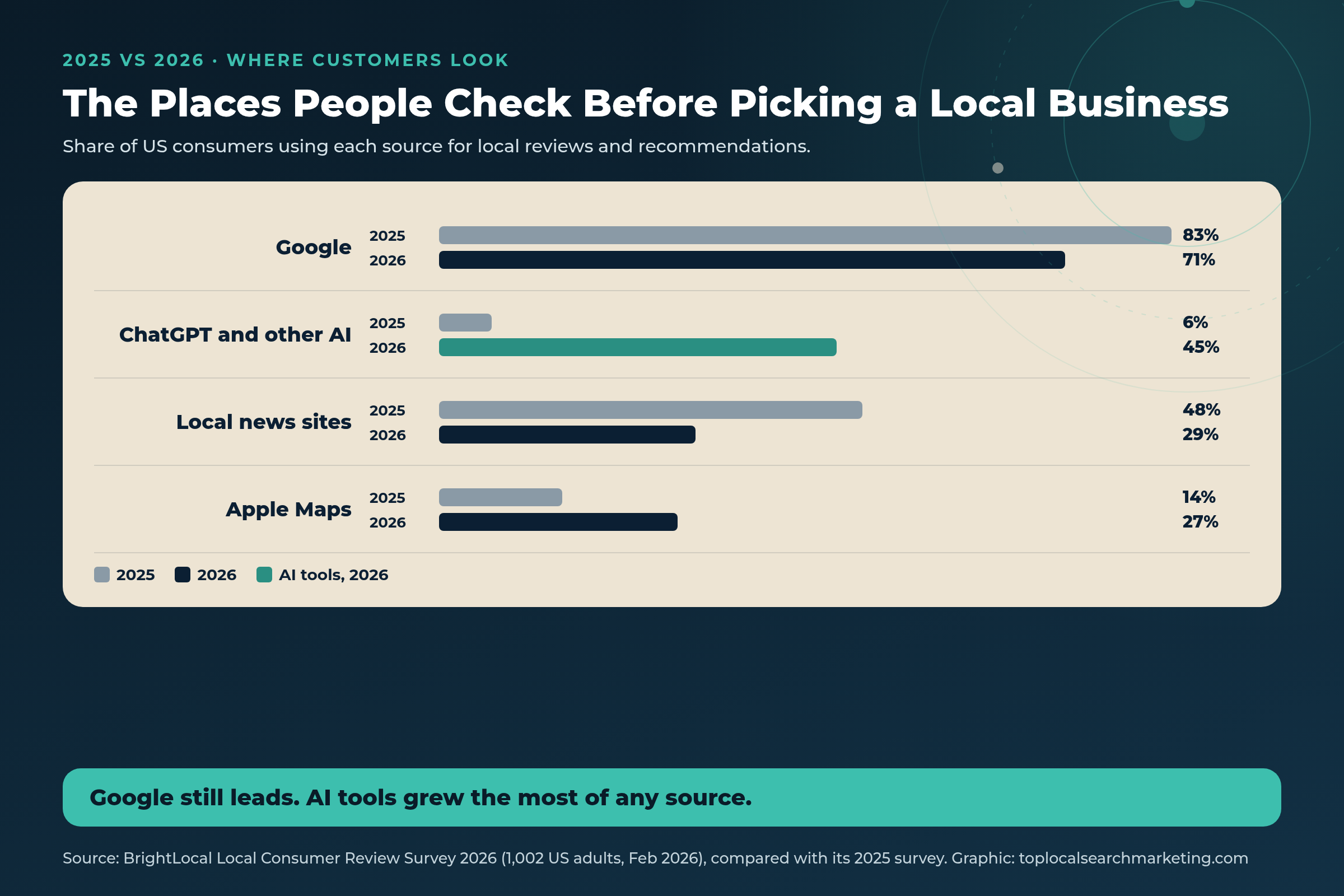
Google fell from 83% to 71%. Apple Maps nearly doubled, from 14% to 27%. Local news sites fell from 48% to 29%. Our take: customers now check more places, so a business that only shows up on Google is leaving gaps.
Do customers trust AI recommendations?
Mostly, yes. Among the 455 people in the survey who had used AI for local recommendations, 63% said they trust its picks and only 10% said they distrust them. Across all 1,002 consumers, 42% trust AI platforms as much as traditional reviews.
Do they still double-check?
Yes, and this is the part owners miss. 97% of AI users sometimes double-check AI recommendations against real reviews, and 42% always check reviews on the review sites themselves. BrightLocal’s read: for many people, AI “has become the first step in local business research rather than the final authority.” So getting named is step one. Your reviews still have to close the deal.
How Does ChatGPT Choose Which Local Businesses to Recommend?
ChatGPT turns the customer’s question into web searches, reads what comes back, and names a few businesses it can back up with sources. OpenAI explains this on its Searching the web with ChatGPT help page:

- It rewrites the question. OpenAI’s own example: if you ask “What are some good restaurants near me?” and your IP address puts you in San Francisco, ChatGPT may search for “top restaurants San Francisco.”
- It uses search partners. OpenAI says ChatGPT search sometimes partners with other search providers and sends them those rewritten searches. The help page points readers to Microsoft’s privacy statement, the company behind Bing.
- It ranks what it finds. In OpenAI’s words, “ChatGPT ranks search results using multiple factors intended to help users find relevant, reliable information. Placement is not guaranteed.”
- It needs to reach your site. To be eligible, OpenAI says to allow OAI-SearchBot to crawl your site and make sure your host or CDN allows traffic from OpenAI’s published IP addresses.
What this means for an owner: when a customer asks for “a good roofer,” ChatGPT is really running something like “best roofer Tulsa” behind the scenes. If your website and listings do not clearly say “roofer” and “Tulsa,” you are not in the pile it reads from.
Our take: this is not magic and it is not random. It is search with an extra step. The businesses that win are the ones that are easy to find, easy to understand, and backed up by other sites.
Call now and find out why your phone isn’t ringing.
Where Does ChatGPT Get Its Information About Local Businesses?
Mostly from business websites and a handful of big listing sites. BrightLocal’s Local AI Visibility Study (September 2026) looked at 200,085 localized, non-branded searches for 1,300 business locations across ChatGPT, Google AI Mode and Google AI Overviews, and nearly 2 million citations.
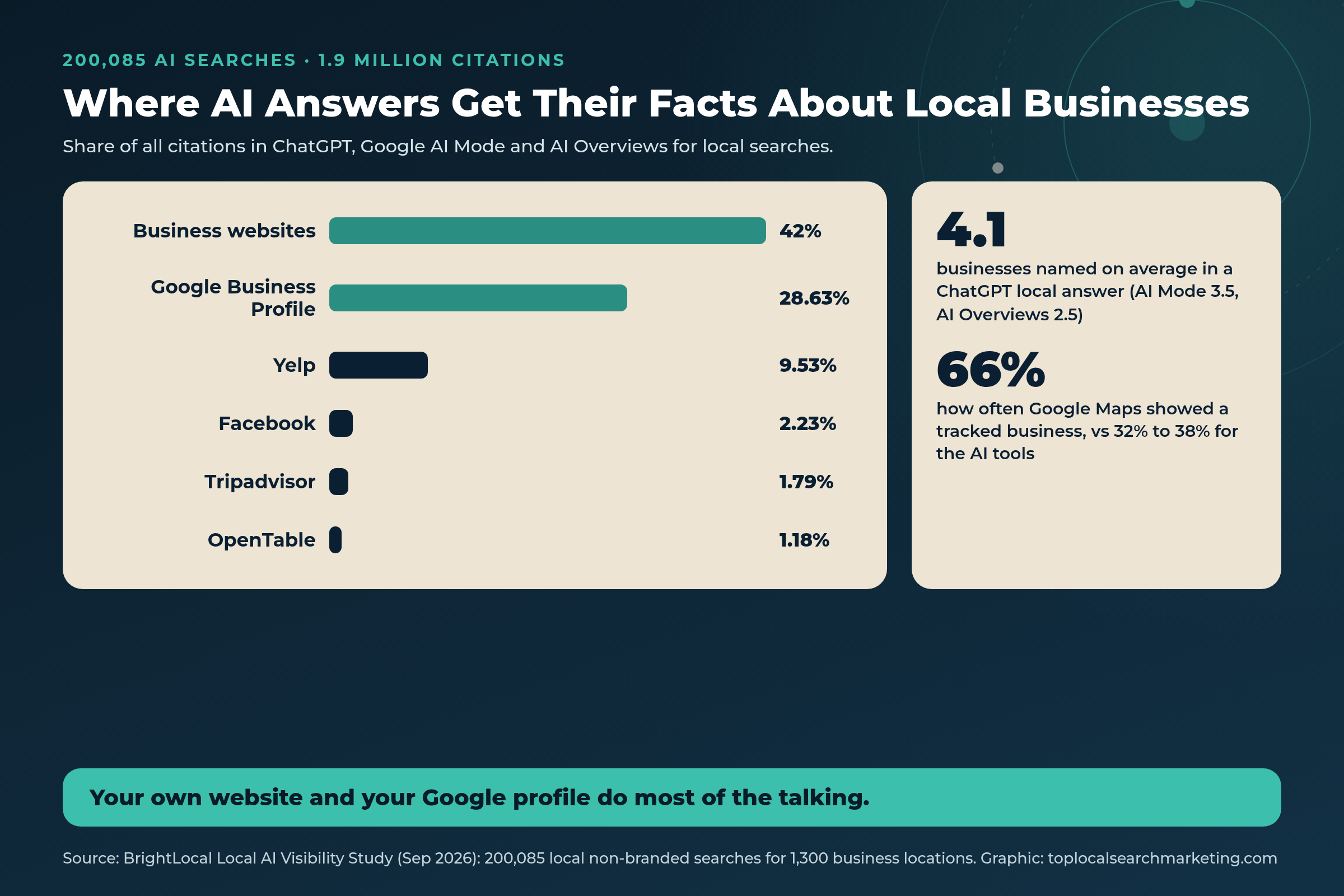
- Business websites made up 42% of all citations. Of about 116,000 source domains, about 108,000 were business websites.
- Google Business Profile was 28.63% of citations, Yelp 9.53%, Facebook 2.23%, Tripadvisor 1.79% and OpenTable 1.18%.
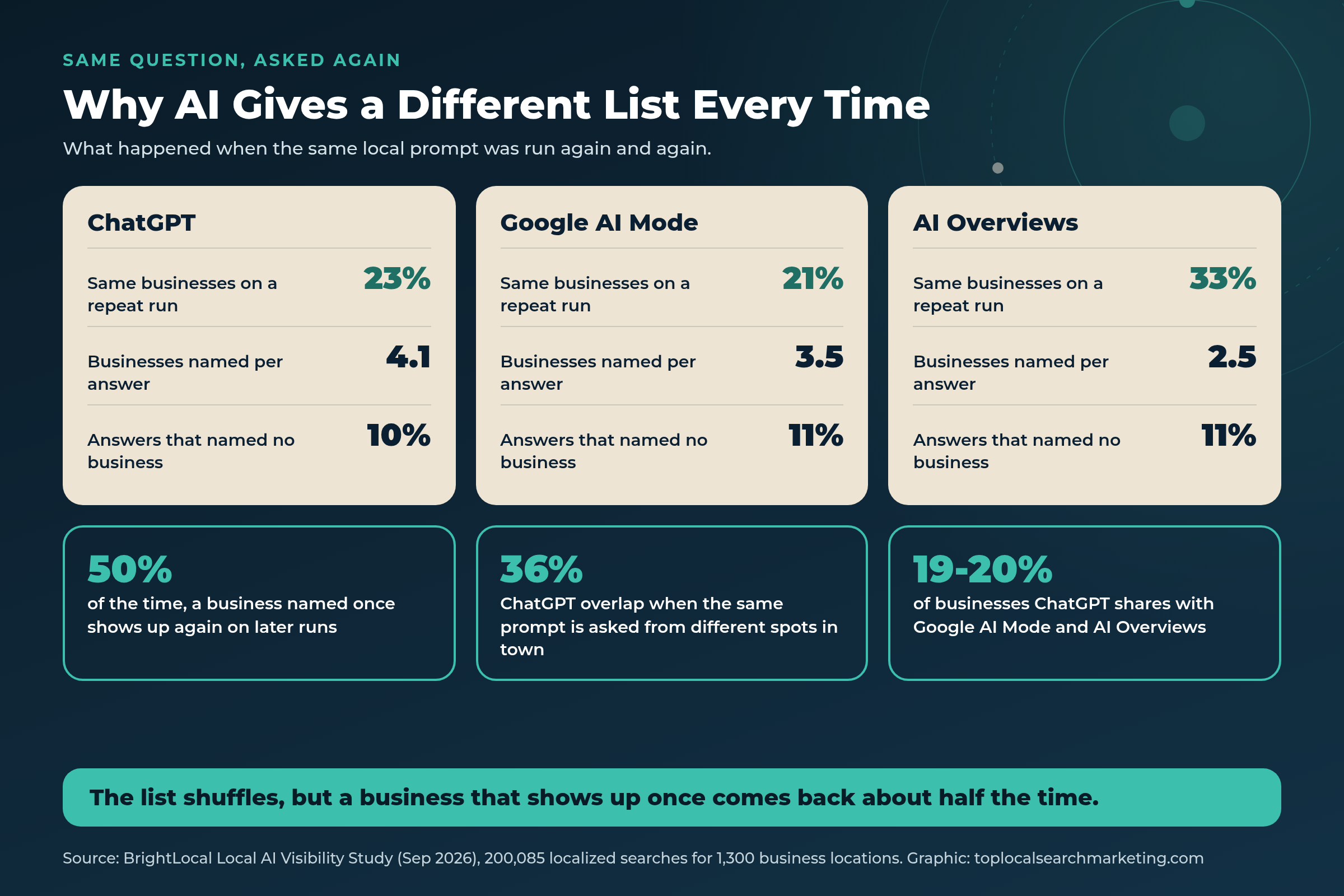
- ChatGPT named 4.1 businesses per answer on average. AI Mode named 3.5 and AI Overviews 2.5.
Does ChatGPT use Google reviews?
Hardly. BrightLocal found Google Business Profile is important for AI Mode and AI Overviews but “hardly used by ChatGPT.” BrightLocal’s CEO, Myles Anderson, put it bluntly: “the likes of ChatGPT and other LLMs and AI search tools can’t see inside Google’s walled garden of reviews.” If all your reviews live on Google, ChatGPT may not see your best proof.
Does ChatGPT use Yelp?
Yes. All three AI tools in the study relied on Yelp, and BrightLocal points to ChatGPT’s relationships with Yelp and Bing as the reason it names different businesses than Google’s AI. For restaurants, OpenAI says ChatGPT can show reservation times from OpenTable, Resy or Yelp. If you run a restaurant and you are not on at least one of those, you are harder to book from inside ChatGPT.
Does Bing matter for ChatGPT?
More than most owners think. OpenAI’s help page lists Microsoft among its search partners’ privacy policies, and BrightLocal ties ChatGPT’s picks to Bing. Claim your free Bing Places listing and add your site to Bing Webmaster Tools. We cover the wider picture in our guide to showing up beyond Google on Bing, Copilot and Yahoo.
Do I still need a website if I have a Google profile?
Yes. Business websites were the biggest single source in the study, at 42% of citations. BrightLocal’s advice is to keep your name, address and phone easy to find and to make each location page clear. A Google profile alone does not cover ChatGPT, which barely reads it. We dug into how Google’s AI links out to websites in this October update.
Why Does ChatGPT Give a Different Answer Every Time?
Because AI answers shuffle. In BrightLocal’s study, when the same local question was asked again, only 23% of the businesses in a ChatGPT answer matched the earlier run. For AI Mode it was 21%, and for AI Overviews 33%.
Two more findings worth knowing:
- Getting named once counts. A business that showed up once came back in about half of later runs.
- Location changes the list. ChatGPT kept only 36% of its picks when the same question was asked from different spots around the same area. It also overlapped just 19% to 20% with Google’s AI tools.
- Sometimes nobody wins. 10% of ChatGPT answers and 11% of Google AI answers named no business at all.
What this means for an owner: do not panic over one screenshot, and do not celebrate one either. Check the same question several times. We wrote more about this in why AI keeps changing its #1 local pick.
Is ranking on Google Maps enough?
No. Google Maps showed a tracked business in 66% of searches, but the AI tools named one only 32% to 38% of the time. Ranking on the map helps, but it does not carry over by itself. Google’s own AI is moving in this direction too, as we covered in how Ask Maps picks one business.
How far away will AI look for a business?
Mostly close. 52.8% to 59.3% of picks were within 5 km (about 3 miles) of the searcher. But ChatGPT casts a wider net: 90% of its picks fell within 287 km, compared with 64 km for AI Mode and 38 km for AI Overviews.
Do service-area businesses get named less?
A little. Storefronts were named in 33.6% of searches, compared with 29.4% for service-area businesses like plumbers and roofers who work at the customer’s home. The gap is small, which means a clear website and strong listings can close it.
Where to Show Up, Tool by Tool
Pulled from the BrightLocal study and OpenAI’s help page in Sources. The last column is our view.
| Where | What it leans on | What to do |
|---|---|---|
| ChatGPT | Business websites, Yelp, Bing. Rarely your Google profile. | Allow OAI-SearchBot, claim Yelp and Bing Places, get reviews off Google too. |
| Google AI Mode and AI Overviews | Your Google Business Profile, websites, Yelp, Facebook. | Fill out your Google profile completely, keep reviews fresh, keep your Facebook page current. |
| Google Maps | Your Google Business Profile, distance, reviews. | The basics still win here: right category, real photos, steady reviews. |
| Your own website (all of them) | Business websites were 42% of all citations in the BrightLocal study. | Put your services, cities, hours and phone number in plain words on your own pages. |
| Restaurants in ChatGPT | Reservation times from OpenTable, Resy or Yelp. | Be bookable on at least one of them. |
Not sure what this would cost to do right? Here is our plain guide to what local SEO services include and cost.
Want to know which of these you are missing?
Call us. We will check your website, Google profile, Yelp and Bing listings and tell you plainly what is holding you back.
Book a Strategy Session Free and no pressure · Call (512) 991-3840 · Text us
Is Your Website Blocking ChatGPT?
It might be, and you would never know. OpenAI’s crawler documentation says sites that opt out of OAI-SearchBot “will not be shown in ChatGPT search answers,” though they can still appear as plain navigation links. OpenAI also says each crawler is set separately: you can allow OAI-SearchBot for search and still block GPTBot, which is about training its models. Changes take about 24 hours to register.
What we found when we checked 30 national brands
On November 3, 2026, we checked the public robots.txt files of 30 national home service and local franchise brands, from plumbing and HVAC to cleaning and painting. Then we loaded each homepage twice: once as a normal browser, and once labeled as OAI-SearchBot.
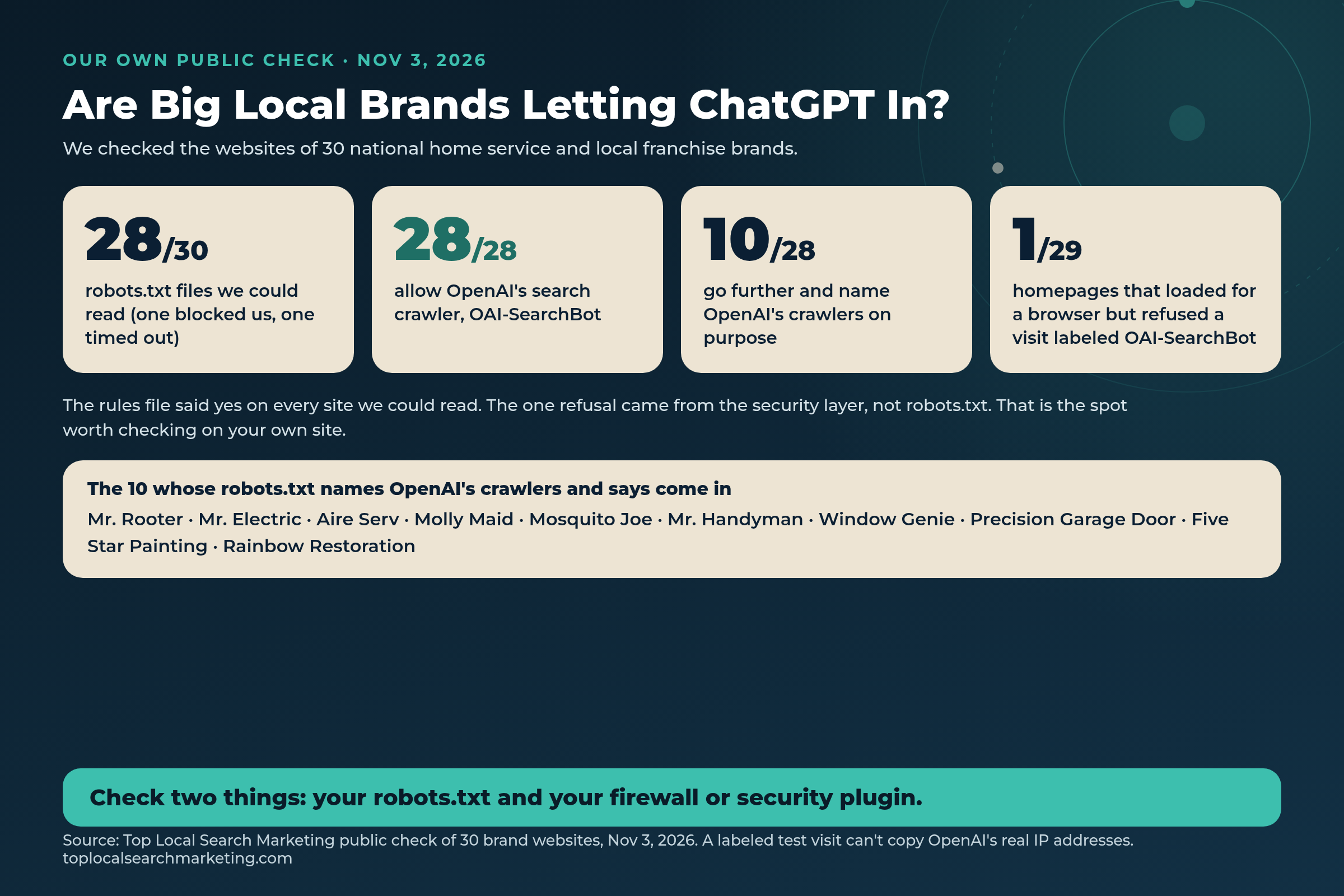
- We could read 28 of the 30 robots.txt files. One site blocked our request and one timed out.
- All 28 allowed OAI-SearchBot. 10 of them, including Mr. Rooter, Molly Maid and Mr. Handyman, named OpenAI’s crawlers on purpose and said come in.
- 1 of the 29 homepages that loaded for a browser refused the visit labeled OAI-SearchBot. Its robots.txt said yes. Its security layer said no.
One honest limit: a labeled test visit is not the real crawler. OpenAI’s crawler comes from its own IP addresses, and a firewall that trusts those may let it in. Firewalls, security plugins and CDN bot settings can quietly block AI crawlers too.
How to check your own site in 2 minutes
- Go to yoursite.com/robots.txt in a browser.
- Look for a line that says
User-agent: OAI-SearchBotfollowed byDisallow: /, orUser-agent: *followed byDisallow: /. Either one is a problem. - Ask your web person or host whether any firewall, security plugin or CDN setting blocks AI bots, and whether OpenAI’s published search crawler IP list is allowed.
Our own site’s robots.txt names OAI-SearchBot, GPTBot and other AI crawlers and lets them in. We think most local businesses should do the same for search.
Call now and find out why your phone isn’t ringing.
Myth vs. Reality
Plenty of advice about AI search is guesswork. Here is what the data and OpenAI’s own pages say.
Myth: You can pay ChatGPT to recommend your business.
Reality: OpenAI says ChatGPT ranks results using multiple factors and that placement is not guaranteed. Be wary of anyone selling a guaranteed spot.
Myth: You have to submit your business to ChatGPT.
Reality: OpenAI’s help page lists no sign-up form. What it asks is that you let OAI-SearchBot crawl your site and do not block OpenAI’s IP addresses.
Myth: If I am #1 on Google Maps, AI will name me too.
Reality: BrightLocal found Maps showed a tracked business in 66% of searches, while AI tools named one only 32% to 38% of the time.
Myth: AI picks are random, so nothing helps.
Reality: The list shuffles, but a business named once came back about half the time, and the sources AI reads are predictable: websites, Google, Yelp, Facebook.
Myth: Reviews matter less now that people ask AI.
Reality: 97% of AI users sometimes double-check AI picks against real reviews. AI gets you on the list. Reviews get you the call.
Book a Strategy Session Free and no pressure · Call (512) 991-3840 · Text us
How to Get Your Business Recommended by ChatGPT: 7 Steps
These are our steps, built from the data above and OpenAI’s own pages. Nobody can promise placement, but these give AI every reason to name you.

-
Let OpenAI’s search crawler in
Check your robots.txt for OAI-SearchBot, and ask your host or web person to confirm no firewall or security plugin blocks AI bots. It is the one thing that can shut you out completely.
-
Make your website say who, what and where
Every main service gets its own page with the service, the towns you serve, your phone number and your hours in plain words. Add short answers to the questions customers really ask. AI rewrites questions into searches like “best roofer Tulsa,” so say it the way a customer would.
-
Fill out your Google Business Profile completely
It is 28.63% of all AI citations in the BrightLocal study and the backbone of Google’s AI answers. Right category, services, hours, real photos. Our Google Business Profile guide walks through it.
-
Claim Yelp and Bing Places, and make them match
ChatGPT leans on Yelp and Bing. Claim your free Yelp for Business and Bing Places listings and use the exact same name, address and phone everywhere.
-
Get steady reviews on more than one site
Google first, then at least one other site your customers use, like Yelp or Facebook. Recent beats old: 74% of consumers only care about reviews from the last three months.
-
Get mentioned on local and industry sites
BrightLocal’s advice is to build listings on relevant niche and local sites and to check the sources AI tools cite. If something is wrong, ask for a correction.
-
Test the same questions every month
Write down five questions a customer would ask, with your city in them. Ask each a few times in ChatGPT and Google AI Mode. Track who gets named and what gets cited. Fix the gaps, then check again.
Get a Free Strategy Session Free and no pressure · Call (512) 991-3840 · Text us
How to Check If ChatGPT Recommends Your Business
Ask it the way a customer would, include your city, and ask more than once. OpenAI’s own tip for better local results is to include your city, neighborhood or ZIP code in the question.
- Write five real questions. For example: “Who is the best emergency plumber in Tulsa?” or “Which roofers in Columbus have good reviews?”
- Ask each one three times. Since only about a quarter of ChatGPT’s picks repeat, one try tells you very little.
- Open the sources. Note which websites and listing sites it cites. Those are the places to fix first.
- Write it down. A simple sheet with the date, the question, who got named and the sources is enough.
What our own Search Console shows
BrightLocal suggests a simple trick: in Google Search Console, filter your queries with the custom regex ^(?:\S+\s+){9,}\S+$ to find long, conversational searches. We ran it on our own site. In our top 1,000 Google searches from August 1 to October 31, 2026, 53 ran seven words or more and 16 ran ten or more.
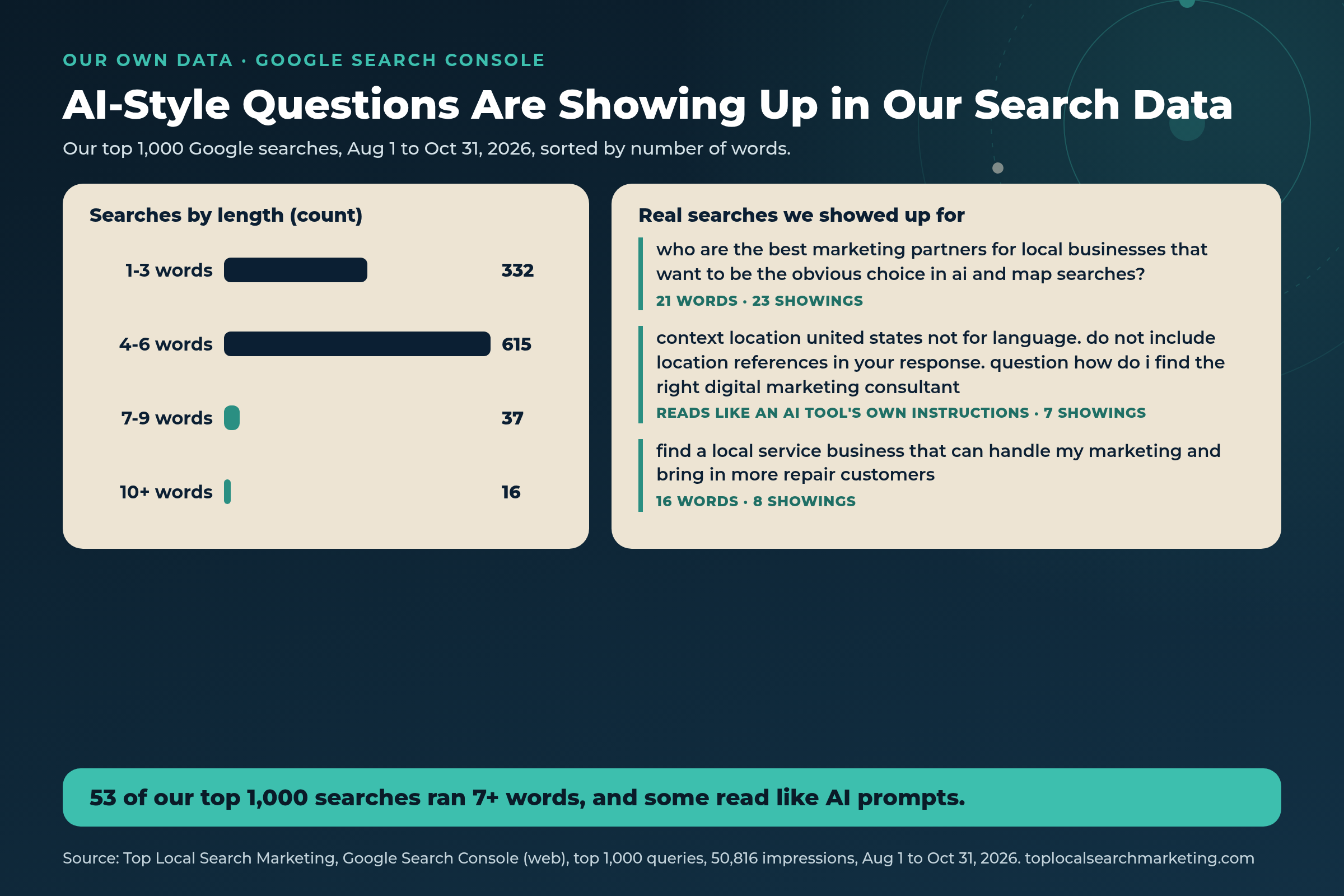
One of them was a full 21-word question about finding marketing partners for “the obvious choice in ai and map searches.” Another read like an AI tool’s own instructions: “context location united states not for language. do not include location references in your response. question how do i find the right digital marketing consultant.” Our take: that is what it looks like when an AI tool turns a customer’s question into searches, the same way OpenAI describes. Check your own Search Console for the same pattern. Those long questions are exactly what your service pages should answer.
If you want to see whether ChatGPT is already sending you visitors and calls, here is our guide to tracking AI traffic and calls.

Quick answer
What is the fastest thing I can do today?
Open yoursite.com/robots.txt and make sure it does not block OAI-SearchBot. Then ask ChatGPT to name the best business for your service in your city, three times, and write down who gets named.
Do Reviews Still Matter If People Use AI?
More than ever. BrightLocal’s 2026 survey found 97% of consumers read reviews for local businesses, and the bar keeps rising:

- 47% won’t use a business with fewer than 20 reviews.
- 74% only care about reviews from the last three months.
- 68% will only use a business with four stars or more, up from 55% in 2025. 31% want 4.5 stars or more.
- 89% expect owners to respond to reviews, and 19% expect a reply the same day.
What this means for an owner: AI might put you on the shortlist, but the customer still clicks through to your reviews before they call. A steady trickle of fresh reviews, answered by you, does double duty. It feeds the AI and it closes the customer.
Our take: the businesses that will win AI search in 2027 are not the ones chasing tricks. They are the ones doing the boring things every week: answering reviews, keeping listings right, and writing plain pages that answer real questions. Our honest advice: start with the free fixes in the steps above before you pay anyone.
If you would rather have it handled, here is how we work at Top Local Search Marketing. Month to month, no long-term contracts. One client per niche per market, so we are not doing the same work for the shop across town. A dedicated account manager who walks you through calls and booked jobs. And no ranking or AI placement promises, because nobody can make them honestly. We are based in Lakeway, Texas, near Austin, and work with local businesses across the United States and Canada. See the full setup on our local SEO and Google Maps page, or start with our plain explainer on what local search marketing is.
Want a plain answer on whether AI recommends you?
Book a free strategy session. We will run the questions your customers ask, show you who gets named, and tell you what we would fix first, whether you hire us or not.
Book a Strategy Session Free and no pressure · Call (512) 991-3840 · Text us
FAQ
Frequently Asked Questions
Straight answers for owners. Sources are linked above and listed below.
There is no sign-up form. OpenAI says ChatGPT ranks search results using multiple factors and that placement is not guaranteed. What you control: let OpenAI’s search crawler (OAI-SearchBot) into your website, make your site say clearly what you do and where, keep your Google Business Profile, Yelp and Bing Places listings complete and matching, and keep fresh reviews coming in on more than one site.
Not in the regular answers. OpenAI’s help page says ChatGPT ranks search results using multiple factors and that placement is not guaranteed. Be careful with anyone who promises you a guaranteed spot in ChatGPT.
Not much. BrightLocal’s study of 200,085 local AI searches found Google Business Profile is important for Google’s AI Mode and AI Overviews but hardly used by ChatGPT. ChatGPT leans more on Yelp, Bing and business websites. That is why reviews on more than one site matter now.
Usually because the sources it reads say more about them: a clearer website, more complete listings on Yelp and Bing, or more recent reviews. The list also shuffles. BrightLocal found only about 23% of the businesses in a ChatGPT answer stayed the same on a repeat run, so test the same question several times before you decide.
That is your call. OpenAI says its crawlers are set separately. GPTBot is about training its models. OAI-SearchBot is about showing sites in ChatGPT search. Sites that block OAI-SearchBot will not be shown in ChatGPT search answers, though they can still appear as plain navigation links. If you want to be recommended, do not block OAI-SearchBot.
OpenAI says a robots.txt change takes about 24 hours to register for search. Everything else, like reviews, listings and website pages, builds over time. Our view: check the same questions once a month and judge it after about 90 days.
Mostly it is the same work with a wider net. BrightLocal found Google Maps showed a tracked business in 66% of searches, while the AI tools named one only 32% to 38% of the time, so ranking on Maps alone is not enough. Add crawler access, Yelp, Bing Places, and a website that answers real customer questions.
Sources
Stats come from the pages below, checked at the source on November 3, 2026. The 30-brand check is our own: we read each brand’s public robots.txt and loaded each homepage as a normal browser and as a visit labeled OAI-SearchBot on November 3, 2026. Search data comes from our own Google Search Console. Anything marked our view or our take is opinion.
- BrightLocal: Local Consumer Review Survey 2026 (1,002 US adults via SurveyMonkey, published Feb 11, 2026)
- BrightLocal: LCRS 2026 AI trust report (455 AI users from the same panel, published Mar 10, 2026)
- BrightLocal: Local AI Visibility Study (200,085 localized searches, 1,300 business locations, published Sep 16, 2026)
- OpenAI Help Center: Searching the web with ChatGPT (checked Nov 3, 2026)
- OpenAI: Overview of OpenAI Crawlers (checked Nov 3, 2026)
- OpenAI: OAI-SearchBot published IP addresses
- Bing Places for Business
- Bing Webmaster Tools
- Yelp for Business
Next step
Be One of the Names AI Gives Your Customers
Nearly half your customers may now ask AI before they call anyone. Let the crawler in, make your website and listings clear, get reviews on more than one site, and test the same questions every month.
If you want a plain read on where you stand, book a free strategy session or contact us. We will tell you what we would do first, whether you hire us or not.
Book a Strategy Session Free and no pressure · Call (512) 991-3840 · Text us · Top Local Search Marketing