
AUSTIN, Texas, Nov. 4, 2026
Google Maps News
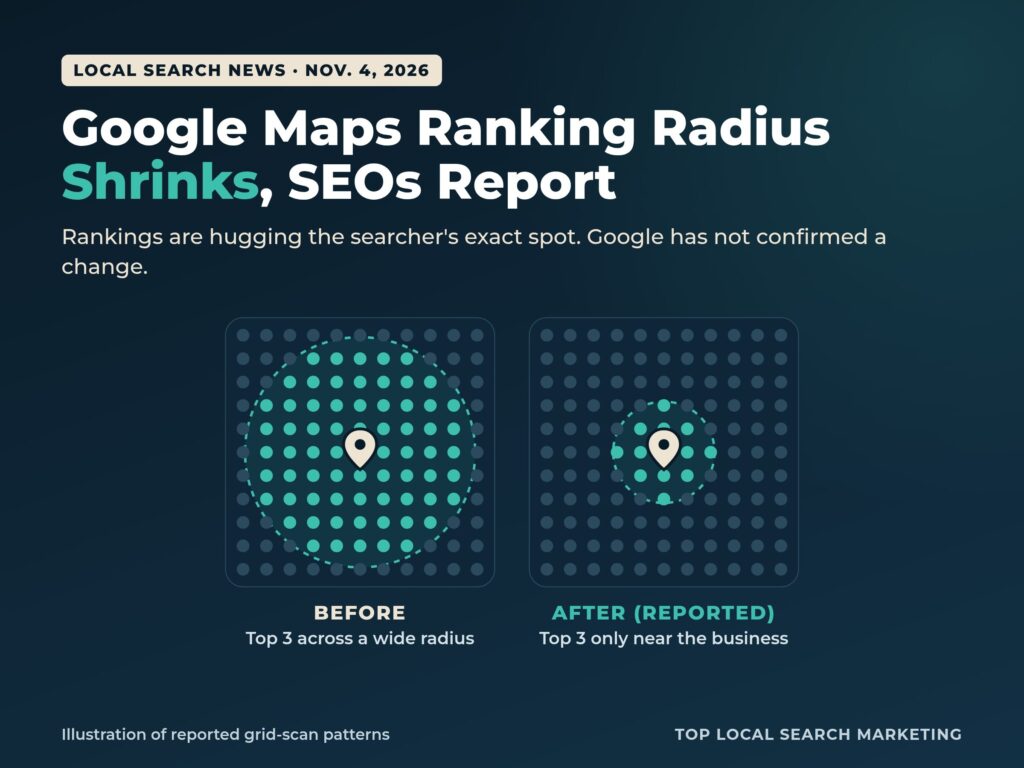
Local SEOs say Google Maps rankings shrank toward the searcher in late October. Businesses that ranked across three to five miles now show up mostly near their own front door. Google has not confirmed any change.
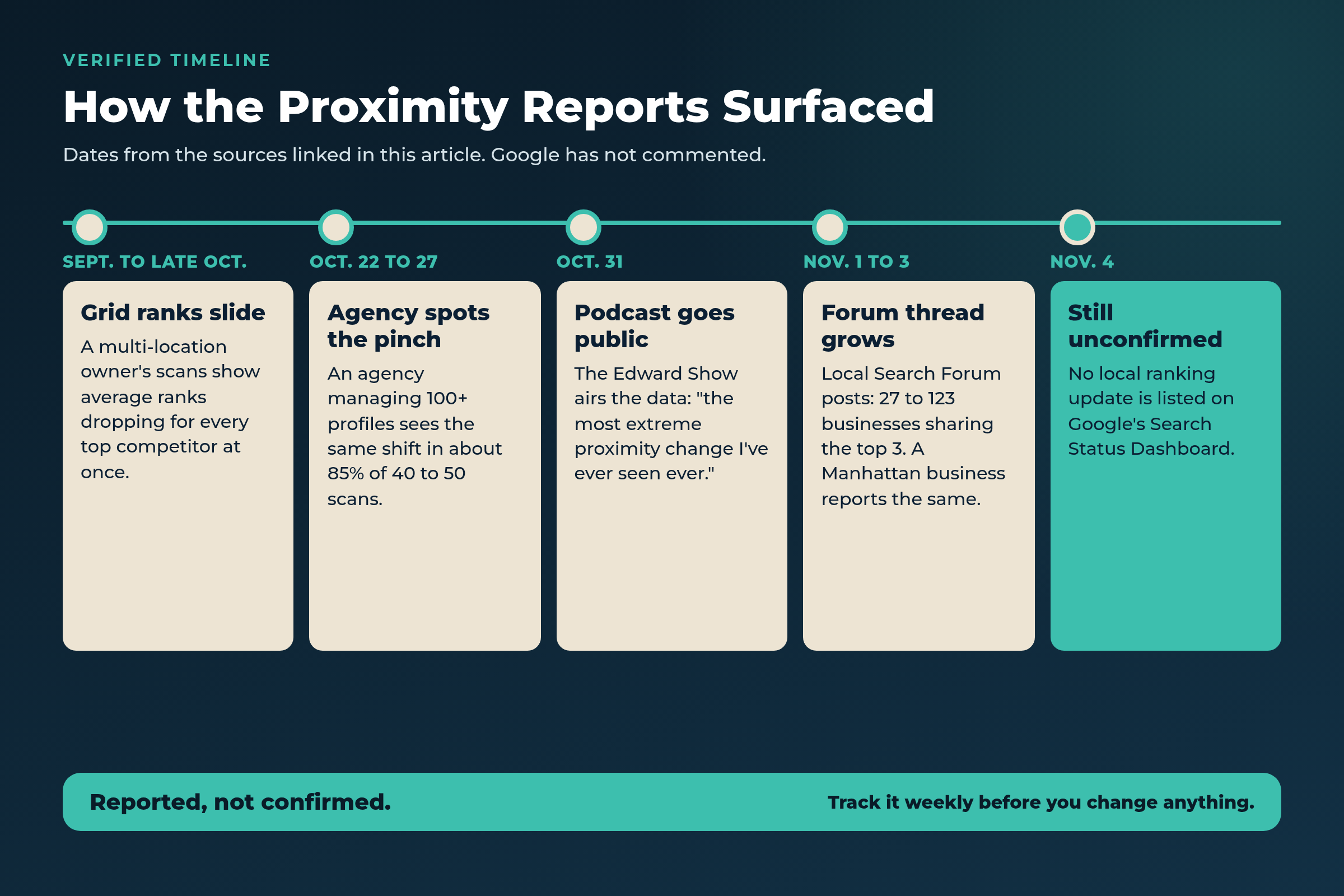
The first public data came Oct. 31 on The Edward Show, where agency owner Matt Hammerton of Brainspike Marketing shared grid scans from the profiles he manages. A separate business owner posted matching numbers on the Local Search Forum on Nov. 1. The two data sets were gathered independently and point the same way.
If your calls dipped in the last two weeks, this may be why.
Key takeaways
What You Need to Know in 60 Seconds
- What is reported: Google Maps and the local 3-pack appear to favor businesses closest to the searcher far more than before.
- When: changes were spotted between Oct. 22 and Oct. 27, 2026, per Hammerton.
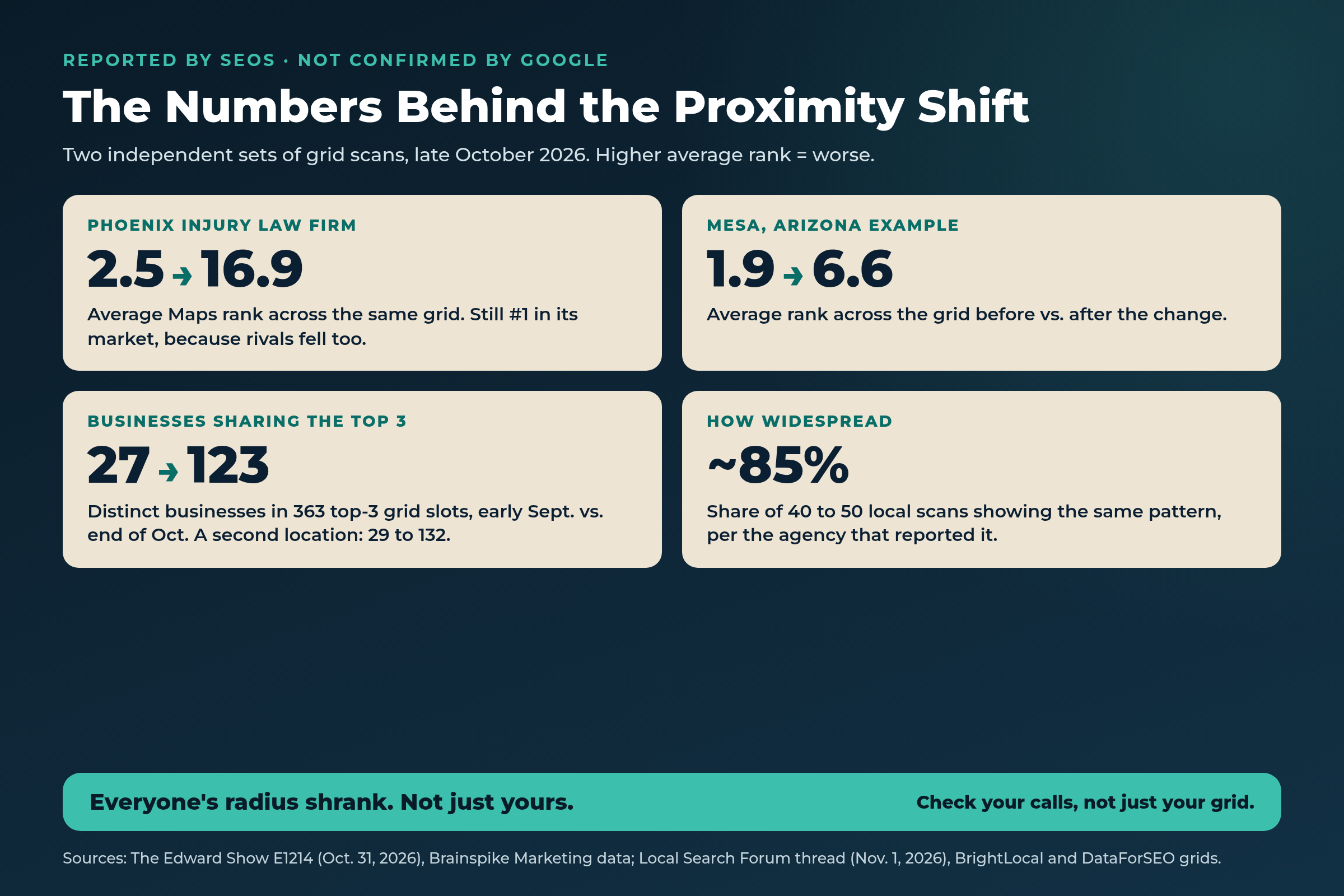
- How big: one Phoenix law firm’s average grid rank went from 2.5 to 16.9, and it was still #1 in its market.
- Who is exposed: service-area businesses and anyone in a dense market full of similar listings.
- Status: not confirmed by Google. It could stick, be tuned, or roll back.
What Happened: Confirmed vs. Reported
Confirmed
- Distance is already one of three main local ranking factors. Google’s Business Profile Help page says: “Local results are mainly based on relevance, distance, and popularity.” It adds: “Distance refers to how far each business is from the customer who’s searching.”
- As of Nov. 4, Google’s Search Status Dashboard lists no ranking update for late October or November. The latest entry is the September 2026 spam update.
- Google has changed this balance before. In 2021 it confirmed: “Our November 2021 local search update has concluded. It began Nov 30 and ran through Dec 8. It involved a rebalancing of various factors we consider in generating local search results,” as Sterling Sky documented.
Reported, not confirmed
- Hammerton says he saw the same pattern in about 85% of 40 to 50 location scans. He called it “the most extreme proximity change I’ve ever seen ever.”
- In his Phoenix personal injury example, the firm he markets fell from a 2.5 to a 16.9 average rank across the same grid. Its rivals fell too, so it stayed on top. A Mesa, Arizona, example moved from 1.9 to 6.6.
- On the forum, an owner counted the distinct businesses holding the 363 top-3 slots on an 11 by 11 grid. “As recently as early September, 27 businesses shared those positions. By end Oct that increased to 123 (4.6x increase). At another location, 29 increased to 132.”
- A Manhattan business on the same thread wrote: “You can literally walk 50 feet and see different Google Maps rankings.”
The caveats matter. The episode notes say: “These proximity findings are based on Matt’s own ranking data. Google hasn’t confirmed the cause, and we don’t yet know whether the changes will remain in place.” Joy Hawkins of Sterling Sky, who runs the forum, warned that rank trackers can be skewed right now: “Incognito is becoming insanely innacurate lately.” The forum poster then checked grid points by hand on a signed-in phone and said they matched. As of Nov. 3, Hawkins said: “I haven’t seen it myself yet but will definitely keep an eye out.”
Why It Matters: Your Map Footprint Drives Your Calls
Most local calls start in the map pack. If your ranking radius shrinks from five miles to one, you lose the searchers in the outer rings, even if you still rank #1 on your own block.
- Service-area businesses like plumbers, HVAC companies, and roofers serve a wide area from one address. A tighter radius hits them hardest.
- Established leaders with hundreds of reviews may lose ground to small, close listings with few reviews.
- Dense markets like downtown law firm clusters see the biggest swings, because there is always a rival nearby.
- Your rank report can mislead you. An average grid rank can crash while your rank versus competitors stays the same.
We covered a related trend in why map pack rankings and calls can drop at the same time.
What You Should Do This Week
Measure first. Act second. Here is the checklist we are running for our own clients.
- Pull a grid scan from mid-October and run a fresh one this week. Same keywords, same grid size.
- Compare your average rank to your top three competitors, not just to last month.
- Spot-check five grid points on a phone signed in to a Google account.
- Check calls, direction requests, and website clicks in your Business Profile performance report, plus your call tracking.
- Do not rename, re-categorize, or move your profile in a panic. Changes can trigger re-verification.
- Do not create virtual offices or fake locations. Follow Google’s guidelines for representing your business.
- Tighten relevance: primary category, services list, and a strong landing page for each core service and city.
- Keep reviews coming steadily and reply to every one.
- If outer-ring calls dropped, cover those zones with Local Services Ads or Google Ads while you wait.
Google’s guidelines for representing your business require a real location. Breaking them costs more than any update.
Get My call with our team Free and no pressure · Call (512) 991-3840 · Text us
Call now and find out why your phone isn’t ringing.
Our analysis
Call now and find out why your phone isn’t ringing.
Our Analysis: What Happens Next
Our analysis, not a Google statement
- Expect more reports first. Two independent data sets agree, but both cover few markets. If the shift is broad, more data will surface within weeks.
- A rollback is possible. Both the forum poster and Hammerton hoped Google would dial it back, since tiny, thin listings are being surfaced. Google has walked back local swings before.
- Relevance becomes the lever. If distance weighs more, the businesses that win outside their block will be the ones that clearly match the search: right category, right services, right landing page.
- Paid coverage gets more attractive. A tighter organic radius pushes owners toward ads for outer zones. Budget a small test now.
Our view on where to invest: local SEO and Google Maps work that builds relevance, steady reviews and clean listings, and targeted Google Ads for the zones you can no longer reach organically. Multi-location brands should review each location’s footprint on its own.
Want to know if your radius shrank?
Get a call with our team. We will run a fresh grid scan, compare it with your competitors, and show you what to fix first.
Get My call with our team Free and no pressure · Call (512) 991-3840 · Text us
FAQ
Frequently Asked Questions
Straight answers for owners. Sources are linked above and listed below.
No. As of Nov. 4, 2026, Google has not announced a local ranking change, and no local update is listed on its Search Status Dashboard. The reports come from SEOs’ own grid scans.
It means Google may be showing businesses that sit closer to the searcher, even if they have fewer reviews. You may still rank well near your address but show up less a mile or two away.
Reports point to dense metro markets with many similar businesses close together. The agency that shared the data says service-area businesses like plumbers, HVAC companies, and locksmiths look especially exposed.
Only if it is a real, staffed location that meets Google’s guidelines. Fake or virtual offices can get a profile suspended. Do not move or edit your address to chase a ranking change Google has not confirmed.
Compare a grid rank scan from mid-October with one from this week. Then check real calls, direction requests, and form leads. Spot-check a few grid points on a phone that is signed in to a Google account.
Nobody knows yet. Google confirmed a local rebalancing in late 2021, and other local swings have faded on their own. Track it weekly before you make big changes.
Sources
Google sources first, then industry reports. Quotes are copied exactly from the linked pages, including original spelling. Anything labeled our analysis or our view is analysis, not a Google statement. See our editorial standards.
- Google Business Profile Help: Tips to improve your local ranking on Google
- Google Search Status Dashboard: Ranking incident history (checked Nov. 4, 2026)
- Google Business Profile Help: Guidelines for representing your business on Google
- The Edward Show E1214: Google Maps Just Shrunk Everyone’s Ranking Radius (Oct. 31, 2026), episode notes and transcript
- Local Search Forum: Google giving extra weight to proximity affecting ranking (thread started Nov. 1, 2026)
- Sterling Sky: The Vicinity Update, Google’s November 2021 local search update
- Search Engine Land: Google proximity bias in local search (guide)
Next step
Get a Fresh Grid Scan Before You Change Anything
A side-by-side scan shows whether your radius shrank and who took the space.
Get the call with our team or contact us. We will tell you what to fix first, whether you hire us or not.
Get My call with our team Free and no pressure · Call (512) 991-3840 · Text us · Top Local Search Marketing