
Google Search Update · October 2026
Maybe you opened your monthly marketing report and your stomach dropped. Your business “fell off page one” for searches you have shown up on for years. But the phone is still ringing and the schedule is still full. So which one is telling the truth?
You are not imagining it. On October 10, 2026, rank tracking company Nozzle published research showing that, since mid-September, some of the Google pages its tools collected came back with most of the normal results swapped out. Search Engine Roundtable and Search Engine Journal covered it within days.
That means a Google ranking report from the last few weeks can show a drop that never happened for your real customers. Here is what changed, what it means in plain English, and a simple checklist to check your numbers with Google’s own free tools.
Start here
The Short Answer
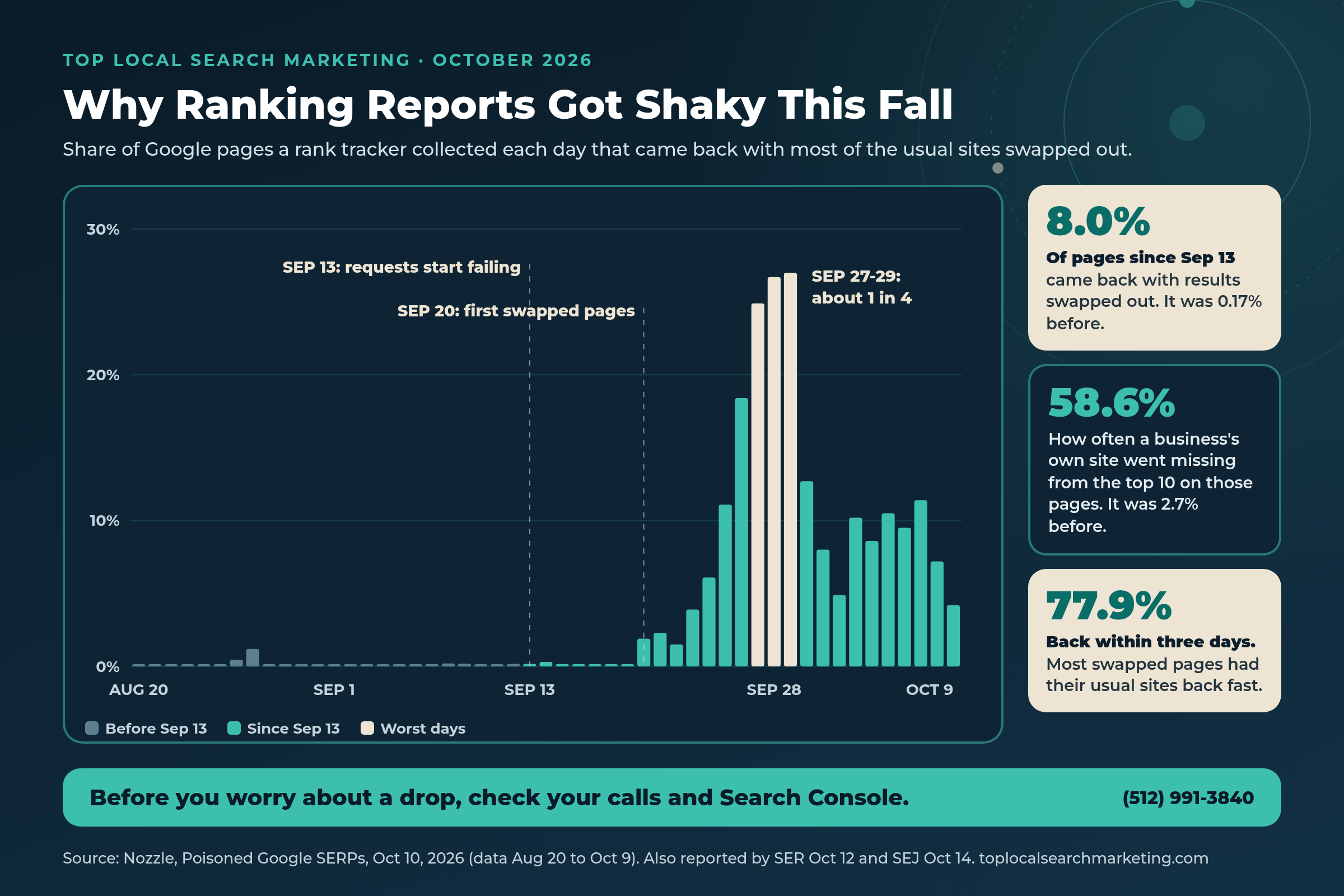
- Some rank reports are off right now: Nozzle found 8.0% of the Google pages it collected since September 13, 2026 had most of their usual sites swapped out, compared with 0.17% before.
- It looks like a real drop: On those pages, a tracked business’s own site was missing from the top 10 more than half the time.
- It usually passes: Most of those pages had their usual sites back within three days.
- “Near me” searches are not spared: They were hit more often than most.
- What to do: Do not panic over a one-day drop. Check your calls, Google Search Console, and your Business Profile before you change anything.
Get My Free Market Report Free and no pressure · Call (512) 991-3840 · Text us
Quick answer
Did my business really drop on Google?
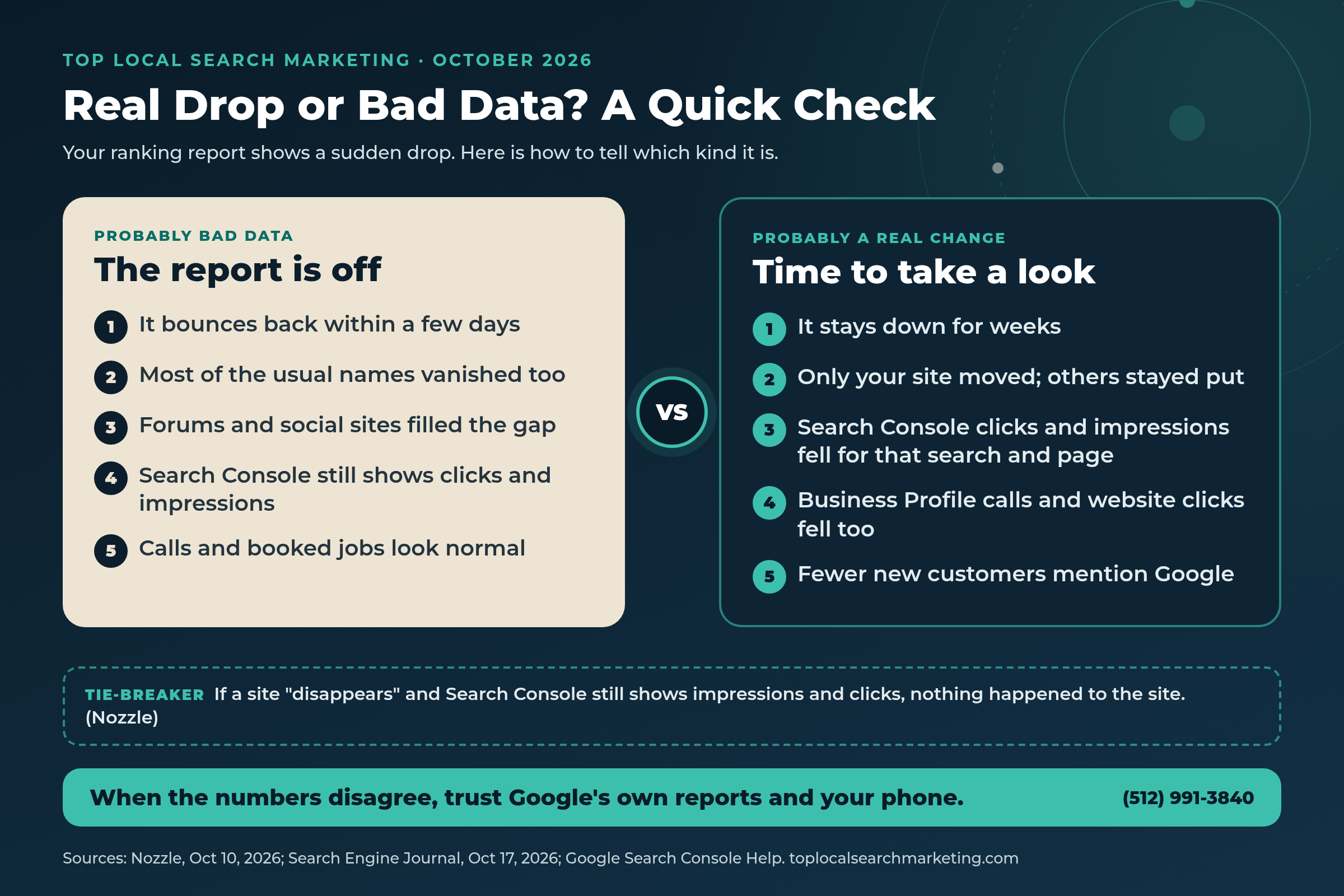
Maybe not. If your report shows a sudden drop but your calls, website visits, and booked jobs look normal, the report may be wrong. Our take: give it a few days, then check Google Search Console. Nozzle says that if a site “disappears” and Search Console still shows impressions and clicks, nothing happened to the site.
Got a scary report this month? That is a stressful thing to sit on.
Start with your Free Market Report. We will look at your real numbers, from Google and from your phone, and tell you plainly whether anything needs fixing.
Get My Free Market Report Free and no pressure · Call (512) 991-3840 · Text us
What Changed This Fall (September 13 to October 17, 2026)
Most ranking reports come from tools that run Google searches automatically, over and over, and write down where each business shows up. Google has been making that harder. Here is the timeline from the reports we read.
September 13: requests start failing. Nozzle reported that its requests to Google started failing in large numbers that day, and for about two weeks fewer pages came through.
September 20: the swapped pages show up. From that date, some pages that did come through looked normal but had most of the usual results replaced. Nozzle calls them “poisoned.” The worst days were September 27 to 29, when it was about a quarter of all the pages it collected. Since October 1, it has run at about 5 to 11% a day.
September 24 to October 8: a real Google update, too. PPC Land pointed out that Google’s September 2026 spam update ran during the same weeks. Real ranking changes and bad tool data would look alike on a chart.
October 7 to 17: the news spreads. PPC Land reported that another data company, DemandSphere, saw wrong results on about 11% of its daily checks. Search Engine Roundtable listed several well-known SEO tools that posted notices about missing or mismatched data. On October 17, Search Engine Journal told marketers to cross-check before putting a one-day drop in a client report.

Our honest view: none of this means your business lost ground. It means one popular way of measuring ground got less reliable for a while.
AI Answer Block
What a Wrong Google Ranking Report Means (Plain English)
Rank tracker: a tool that searches Google for a list of phrases, like “plumber near me,” and records where your business shows up. Most monthly ranking reports are built this way.
Swapped results: Nozzle found pages that were complete, with no error and no “are you a robot” check, but most of the usual sites were gone. On normal pages, the results kept 88.5% of the sites from the last check. On the swapped pages, only 20.7%. Social sites and forums like Reddit, Facebook, and Quora filled the gaps.
Why your site “vanished”: When a business’s own site normally ranked for a search, it was missing from the top 10 on 58.6% of swapped pages, compared with 2.7% before. That is how a normal week turns into a scary report.
Why it is happening: Nozzle believes it is Google’s response to companies scraping its results to feed AI answers, and rank trackers collect pages the same way, so they got caught in it. Search Engine Roundtable shares that view. Google has not confirmed it.
Google Search Console: Google’s free report for website owners. Its Performance report shows clicks, impressions, and average position straight from Google, not from a tool’s sample.
Our reading: the tool is not broken every day. But a single bad day can now look exactly like a real drop, so every surprise needs a second source.
Quick answer
Does this change how my business shows up for real customers?
These reports are about pages served to automated tools, not to your customers. PPC Land described them as pages Google served only to suspected bots. Your real visibility is best measured by Google’s own data and by your phone.
Why Local Owners Should Care
For a local business, a bad report is not just a number. It can lead to rushed decisions: rewriting your website, changing your Google listing, or switching marketing help, all over a drop that was never real.
And the searches local customers use most were hit harder than most. Nozzle found that 11.4% of “near me” searches came back swapped, against 7.8% of everything else. It also varied by industry in the U.S. data: legal at 15.9%, home services at 12.7%, health and medical at 7.5%, restaurants and food at 7.3%, and automotive at 5.3%.

Picture a plumber in Buffalo or anywhere in Western New York who sees “emergency plumber near me” drop to page three on Monday, then bounce back by Thursday. Or a med spa in Austin, a family law office in Nashville, or a restaurant in Lexington, KY getting the same scare. Nozzle found that most swapped pages had their usual sites back within three days, two days at the median.
There is one more thing worth knowing. Google’s own Search Console help page says search results are specific to “the time, place, device, and recent history of the person searching.” And its local ranking page says local results are mainly based on relevance, distance, and popularity. So the search you run from your shop counter is not what a customer sees from across town.
Our take: there is no single “real” ranking for a local business. There is what your customers see where they are, and there is whether they call you.
You should not have to guess whether your marketing is working.
We will look at your Search Console, your Business Profile, and your last few weeks of calls with you, then hand you a short, plain list of what to do next, if anything.
Who does AI name in YOUR market?
Get the free $500 Market Report — Map Pack gaps, Ask Maps visibility, and the competitor capturing your calls.
- Who Google Maps and AI (ChatGPT, Gemini, AI Overviews, Ask Maps) recommend in your market
- The competitor getting the calls you should be getting, by name
- Your 4-point conversion check + 90-day roadmap
Prefer to talk? Call (512) 991-3840
Myth vs. Reality
A calm reset on what these reports do and do not mean.
Myth: If my report shows a drop, I lost customers.
Reality: Not always. Nozzle found a tracked site went missing from the top 10 on 58.6% of swapped pages, and most came back within three days. Check calls and Search Console first.
Myth: Searching my business on my own phone shows my real ranking.
Reality: Google says results depend on the time, place, device, and recent history of the person searching. Your phone at the shop is not a customer’s phone across town.
Myth: Local searches are safe from this.
Reality: “Near me” searches were hit more than most: 11.4% against 7.8%. On swapped pages, the map pack kept 60.5% of its usual businesses, against 85.8% before.
Myth: Google confirmed it is doing this.
Reality: It has not. Search Engine Journal noted the report has no statement from Google, and PPC Land said Google has not commented on either company’s numbers.
Myth: Rank trackers are useless now.
Reality: They still help show trends over time. Nozzle found 80% of these problems lasted a single check. Use the tool, but pair it with Google’s own numbers.
Myth: I can pay Google to fix my local ranking.
Reality: Google’s help page says there is no way to request or pay for a better local ranking on Google.
A Simple 8-Step Checklist When Your Google Ranking Report Looks Wrong
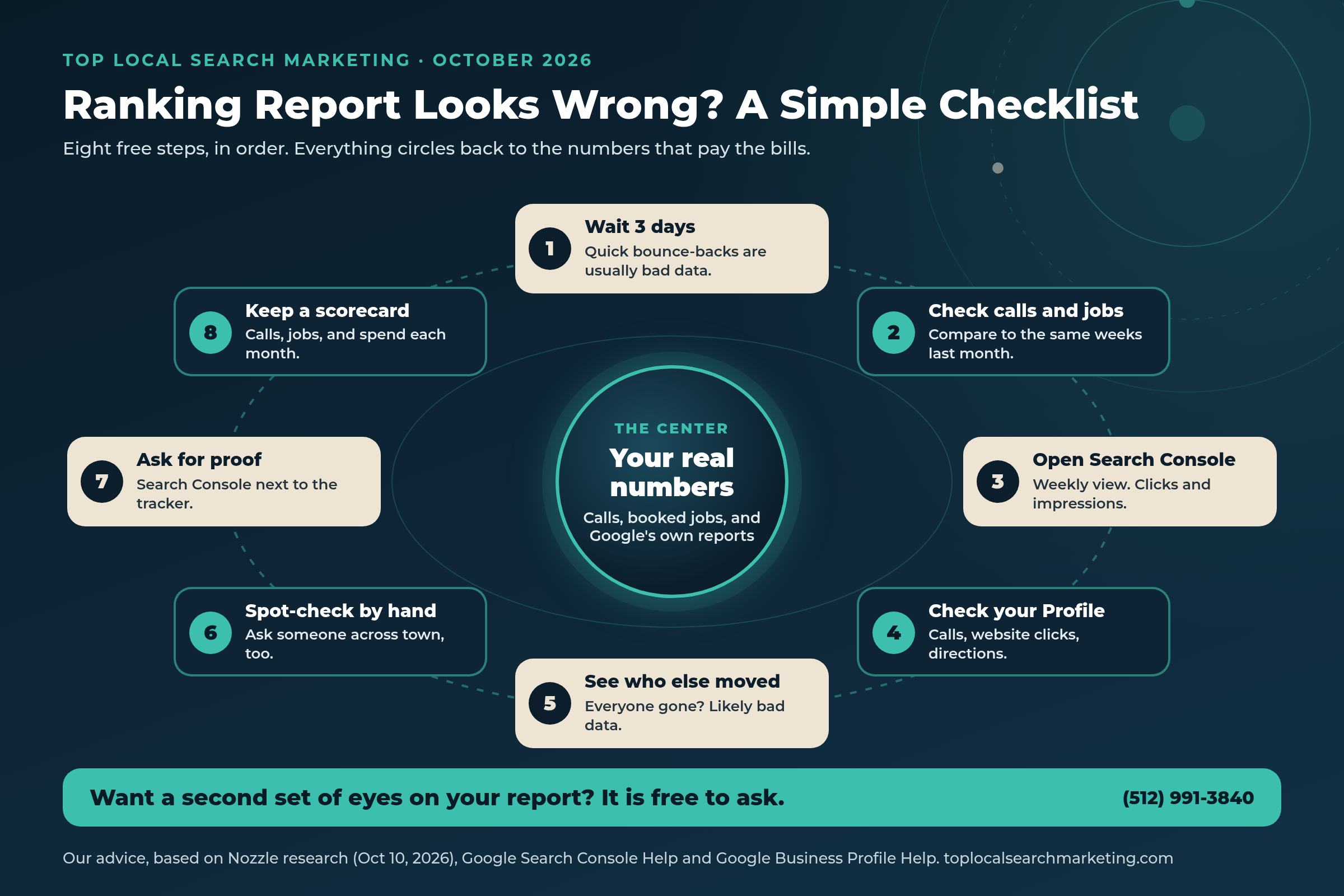
These are our steps, not a Google product. Most take a few minutes, and none of them cost anything.
-
Wait three days before you react
A one-day drop that bounces back is most likely bad data. Nozzle found most swapped pages had their usual sites back within three days.
-
Check your phone and your schedule
Compare calls, form fills, and booked jobs to the same weeks last month. If those look normal, your customers are still finding you.
-
Open Google Search Console
In the Performance report, compare date ranges and switch to the weekly view, which Google says smooths out daily ups and downs. Look at clicks and impressions for the search and page in question.
-
Open your Business Profile Performance
See calls, website clicks, and direction requests. The list of search terms updates at the start of each month and can take up to five days to show.
-
Look at who else moved
If most of the usual names vanished too and forums or social sites took their place, it is likely bad data. If only you dropped, it is more likely real.
-
Spot-check a few searches by hand
Search a few of your main phrases yourself, and ask a friend or customer across town to do the same. Remember that place and device change what people see.
-
Ask how your report gets checked
Ask whoever sends your report how they double-check a sudden drop, and ask to see Search Console numbers next to the tracker.
-
Keep a simple monthly scorecard
Write down calls, booked jobs, and what you spent each month. Ask every new customer “How did you hear about us?” and write that down too.

Where to Check Your Real Numbers
Keep this handy the next time a report surprises you. Details come from the pages in Sources.
| Where to look | What it tells you | Best for | Good to know |
|---|---|---|---|
| Rank tracker report | Where a tool saw you on a list of searches | Spotting trends across many searches | Since mid-September 2026, some pages served to these tools had results swapped out |
| Google Search Console | Clicks, impressions, and average position from Google | Checking whether a drop is real | Free for website owners; the newest data can be preliminary |
| Business Profile Performance | Calls, website clicks, direction requests, and search terms | Seeing what people do on your Google listing | Free for verified profiles; search terms update monthly |
| Searching it yourself | What one person sees in one place, on one device | A quick sanity check | Not what a customer across town sees |
| Your phone and calendar | Calls, form fills, and booked jobs | Knowing if marketing pays | Ask every new customer how they found you |
One note on Business Profile numbers: Google’s performance help page says they include views and actions from both regular search results and Google Ads, and that “Calls” counts taps on the call button on your profile.
If this feels like one more thing on your plate, you do not have to sort it out alone.
You run the business. With your Free Market Report, we will walk through your reports in plain English and show you which numbers to trust.
Get My Free Market Report Free and no pressure · Call (512) 991-3840 · Text us
What NOT to Do
Do not rewrite your website or change your Google Business Profile because of a one-day drop. If the drop was bad data, you risk breaking things that were working.
Do not judge your marketing on a chart from late September alone. Those weeks had the worst of the swapped pages and a real Google spam update running at the same time.
Do not chase the forum and social results that showed up in your report. On swapped pages, Reddit and Facebook appeared more often than usual, so they may not be what your customers see.
Do not pay anyone who promises to “fix” your Google ranking fast. Google says there is no way to request or pay for a better local ranking.
Our advice: when the numbers disagree, trust Google’s own reports and your phone.

The real question is simple: are the right people still calling you?
If you would like help finding out, and getting more of them, we are easy to reach.
Get My Free Market Report Free and no pressure · Call (512) 991-3840 · Text us
FAQ
Frequently Asked Questions
Straight answers for owners. Sources are linked above and listed below.
It may be the report, not your business. Since mid-September 2026, rank tracking company Nozzle found that 8.0% of the Google pages it collected came back with most of the usual sites swapped out, compared with 0.17% before. Check your calls and Google Search Console before you change anything.
It is Nozzle’s word for Google pages that look complete and normal but have most of a search’s usual results replaced. They showed up in pages collected by automated tools. PPC Land put it this way: some September and October 2026 numbers may describe pages real searchers never saw.
The study looked at Google Search pages, including the map pack shown on them. On the swapped pages, the map pack kept 60.5% of its usual businesses, against 85.8% before. That is what the tool recorded, not a change to your listing. Our advice: check the calls and direction requests in your Business Profile.
Google has not confirmed it publicly. Nozzle and Search Engine Roundtable both believe it is aimed at companies scraping Google for AI answers, and rank tracking tools got caught in it. Search Engine Journal noted that the report does not include a statement from Google.
Use Google’s own tools. The Search Console Performance report shows clicks, impressions, and average position for your website. Business Profile Performance shows calls, website clicks, direction requests, and the search terms people used to find you. Keep in mind Google says results depend on the time, place, device, and recent history of the person searching.
Not over one report. Ask them to show Search Console and Business Profile numbers next to the tracker, and look at the trend over a few weeks. Our advice: judge any marketing by calls, booked jobs, and what you spent.
Sources
Every figure in this post comes from the pages below. The swapped-results numbers are Nozzle’s own measurements, not Google’s. Opinion is labeled as ours.
- Nozzle Research: Poisoned Google SERPs (Oct 10, 2026, data through Oct 9)
- Search Engine Roundtable: Third-party Google rank tracking struggling now (Oct 12, 2026)
- PPC Land: Google returns wrong results on 11% of DemandSphere’s daily rank checks (Oct 13, 2026)
- Search Engine Journal: Analysis, Google is poisoning search results for rank trackers (Oct 14, 2026)
- Search Engine Journal: SEO Pulse, rank tracker data (Oct 17, 2026)
- Google Search Console Help: Performance report (Search results)
- Google Business Profile Help: Understand your Business Profile performance
- Google Business Profile Help: Tips to improve your local ranking on Google
Next step
Let’s Look at the Numbers That Pay the Bills
This fall, a lot of ranking reports picked up bad data from Google pages served to automated tools. Our steps turn that into a calm habit: wait a few days, check Google’s own reports, look at your calls, and keep a simple monthly scorecard.
If you would like a second set of eyes, get your Free Market Report. We will go through your reports and your real numbers and leave you with a short, plain list either way.
Get My Free Market Report Free and no pressure · Call (512) 991-3840 · Text us · Top Local Search Marketing
Where this fits: Rankings only matter if the phone rings. Our local SEO services come with call tracking and plain reporting so you can see what’s working.